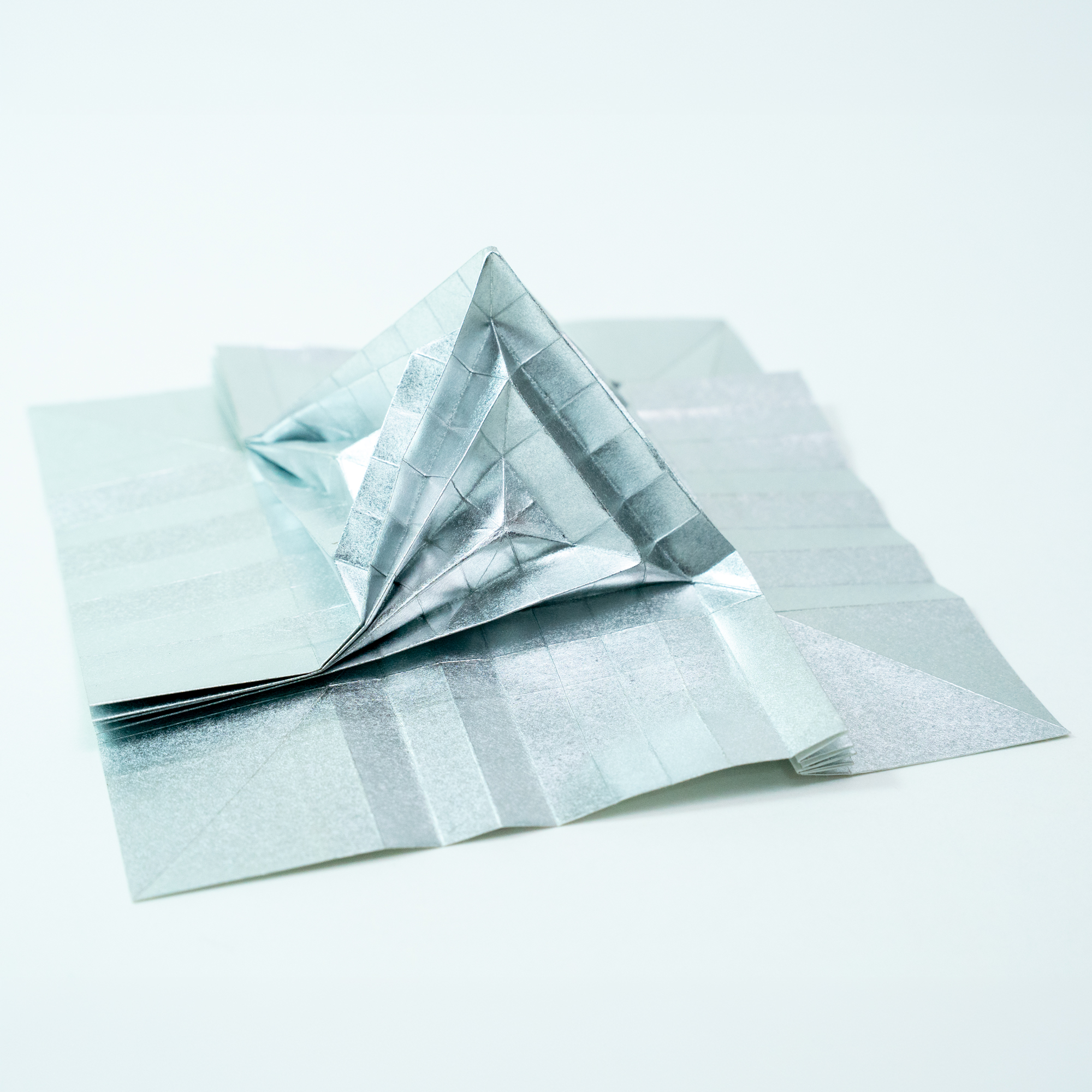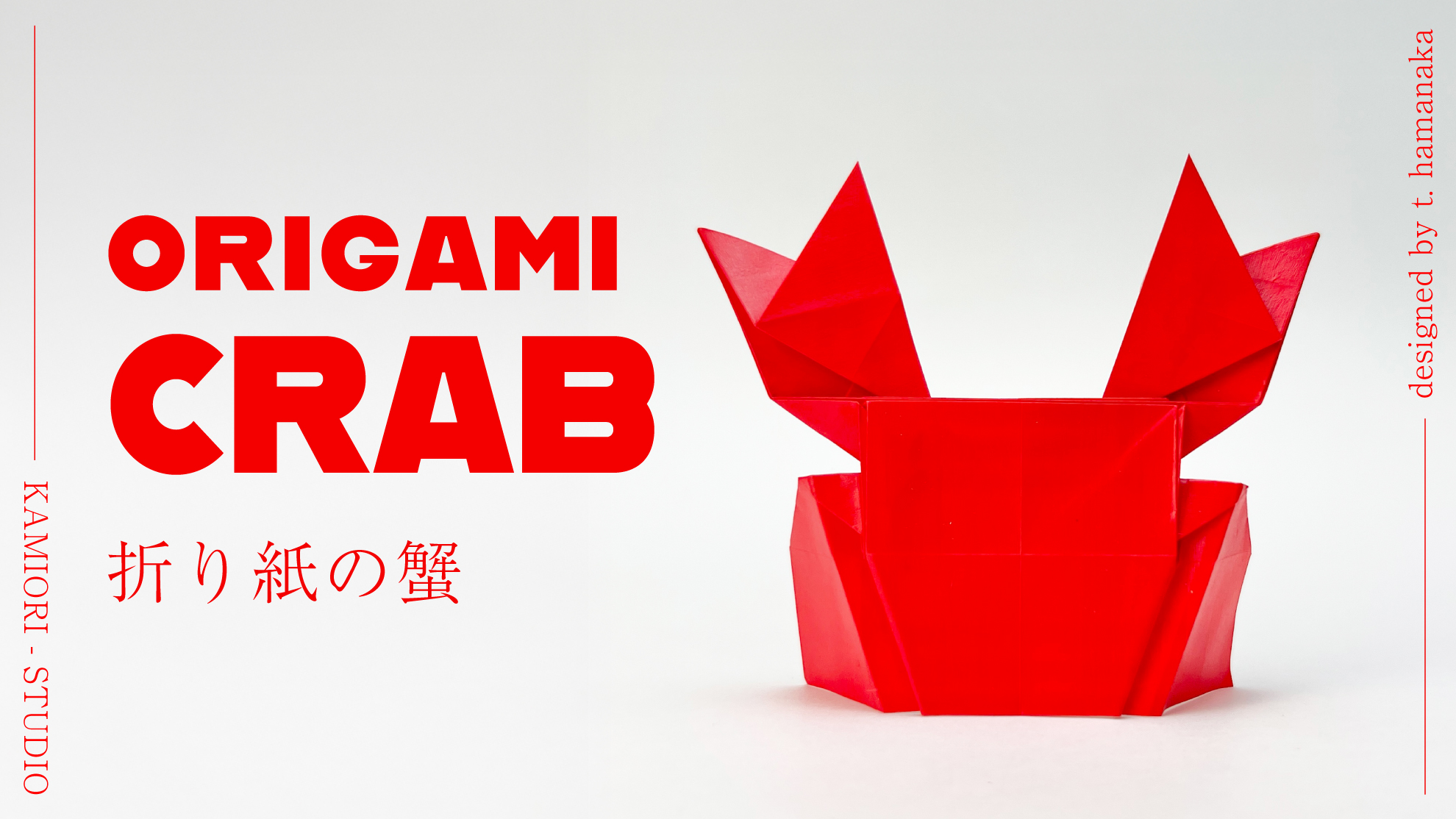
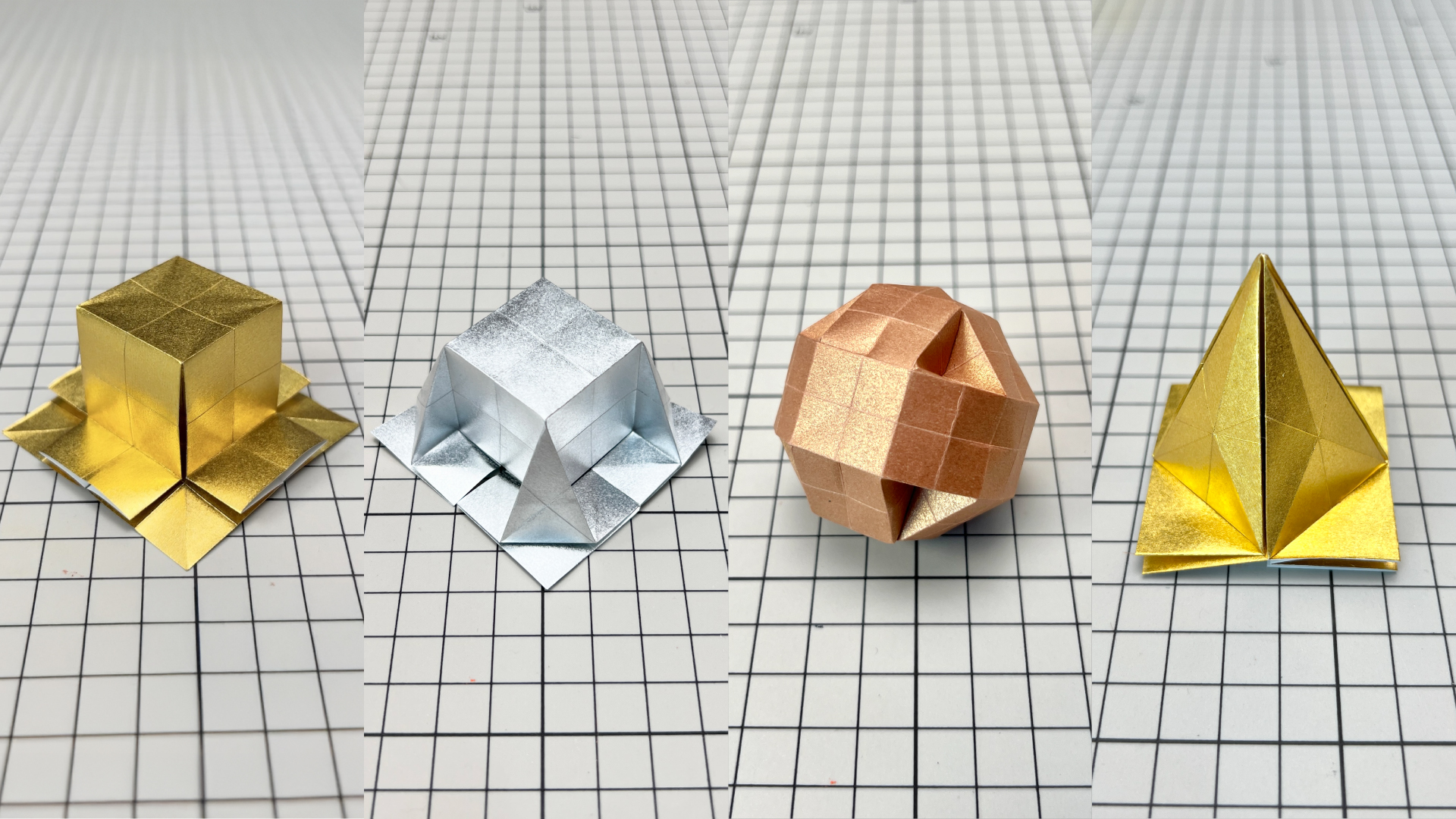
Polygon Components are a design concept developed by Kamiori-Studio for constructing three-dimensional forms using origami molecules that cannot be folded flat, treating them as structural units built from faces and corners.
As the folding process progresses, these components naturally rise into three-dimensional forms, producing sharp-edged, polygonal shapes. This emergent volumetric quality is a defining characteristic of polygon components. By working with these non-flat origami molecules, Kamiori-Studio explores three-dimensional origami expressions in which realism and abstraction coexist.
The Concept of Origami Molecules
To design an origami work, it is first necessary to consider a blueprint. This blueprint is generally called a crease pattern , which records all mountain and valley folds on the paper in its fully unfolded state.
When drawing crease patterns for multiple works, one begins to notice something:
even among completely different works, recurring patterns of folding methods appear.
These reusable structural units are called origami molecules.
Origami molecules have the following characteristics:
- They are a collection of crease lines grouped into a coherent unit
- Each molecule can be folded on its own
- By combining multiple molecules, an overall structure can be formed
Origami Design Based on Flat Molecules
In conventional origami design, structures that can be folded flat have often been emphasized.
This can be considered a natural tendency due to factors such as mathematical and geometric tractability and the ease of organizing crease patterns.
As a result, the assumption that
origami molecules = flat-foldable structures
has been implicitly shared.
However, through close observation of many crease patterns during the design process, it became clear that certain patterns cannot be folded flat.
This was especially evident in patterns found within accordion-fold structures.
These structures exhibit the following characteristics:
- They naturally become three-dimensional as folding progresses
- They cannot be fully returned to a planar state
- The folding itself presupposes a three-dimensional form
When such non-flat origami molecules are used to create shapes, a clear tendency emerges: surfaces become clearly segmented and edges are emphasized. The resulting forms often resemble polygonal models seen in early 3D video games.
For this reason, Kamiori-Studio refers to this class of non-flat origami molecules as polygon components.
Structural Classification of Polygon Components
Polygon components are not a single shape, but can be systematically organized as variations of three-dimensional structures.
At Kamiori-Studio, polygon components are classified starting from basic cube structures, including variations such as truncation, distortion, perforation, banded structures, and forms extracted from the constituent elements of cubic structures.
1. Basic Components
These are the most fundamental polygon components. By combining them, more complex components can be created.
Obtuse Triangular Pyramid

A flattened triangular pyramid whose apex solid angles are all 90 degrees.
It is used as a fundamental element for forming the vertices of cubes and rectangular prisms.
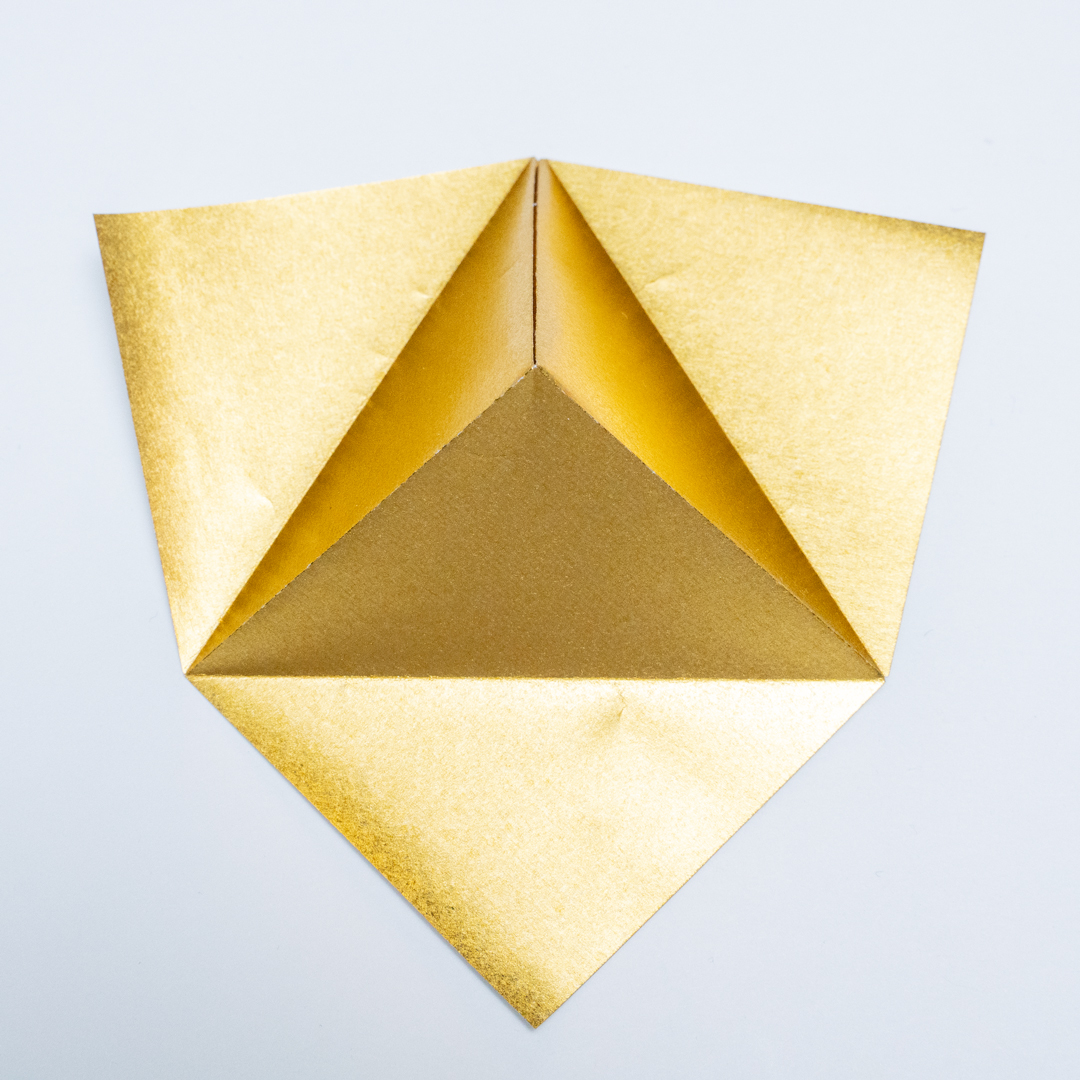
Obtuse Triangular Pyramid
A flattened triangular pyramid whose apex solid angles are all 90 degrees. It is used as a fundamental element for forming the vertices of cubes and rectangular prisms.
Acute Triangular Pyramid

A slender triangular pyramid with a sharply elongated apex and high structural stability.
On its own, it is well suited for creating horn-like forms.
By combining multiple units, it can form solid structures such as cubes and square pyramids, making it highly versatile.
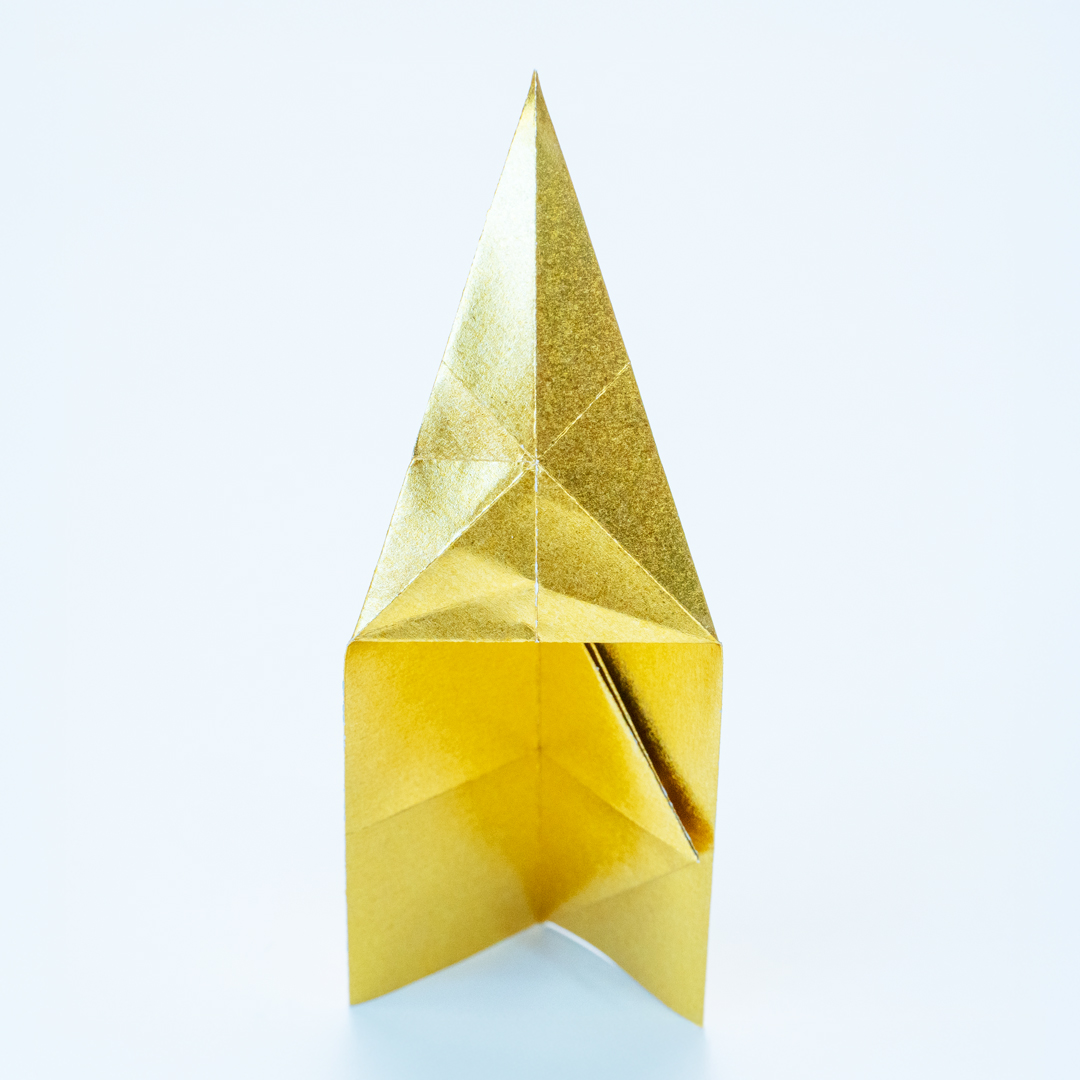
Acute triangular pyramid
A slender triangular pyramid with a sharply elongated apex, offering strong structural stability. On its own, it is well suited for creating horn-like forms. By combining multiple units, it can be extended into solid structures such as cubes and square pyramids, making it a highly versatile structural element.
2. Cubic-Based Components
These highly versatile components are based on cube structures. They employ techniques such as volumetric folding, three-dimensional sink folds, and transformations from basic forms, serving as starting points for structural understanding and application.
Basic Cube
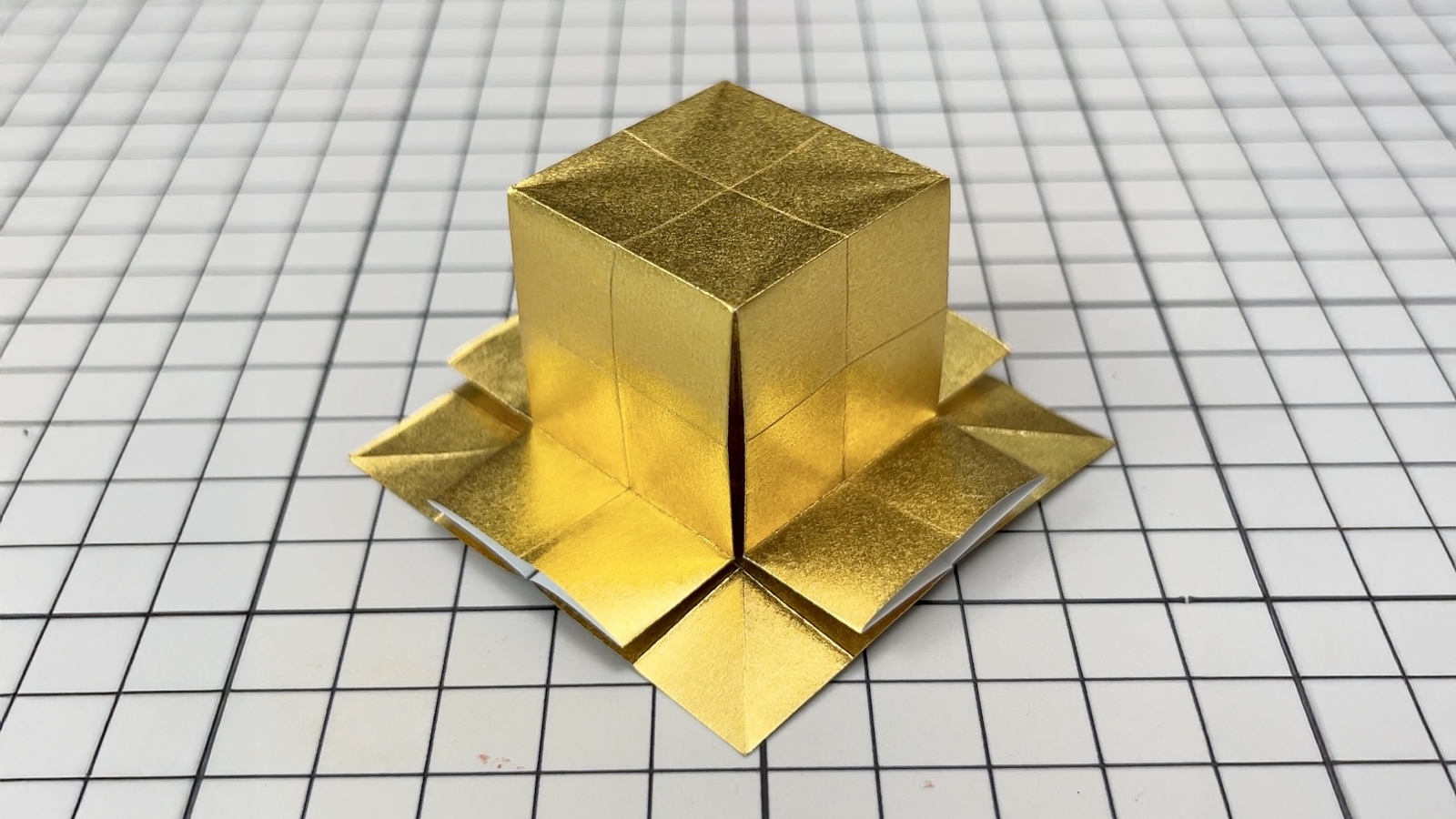
The fundamental cube form.
A basic structure for understanding the relationship between faces and corners.
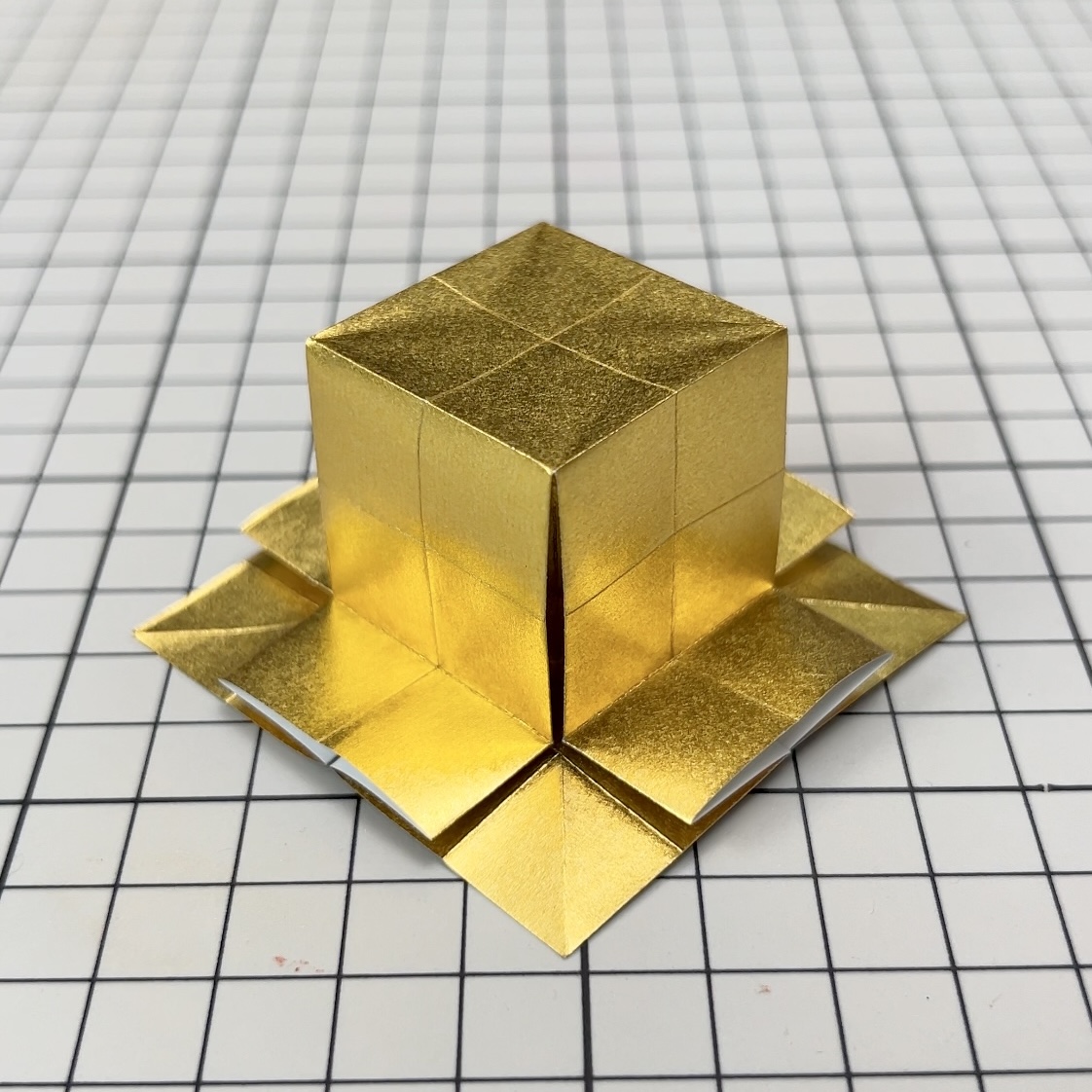
Basic Cube
The fundamental cube form. A basic structure for understanding the relationship between faces and corners.
Banded Cube
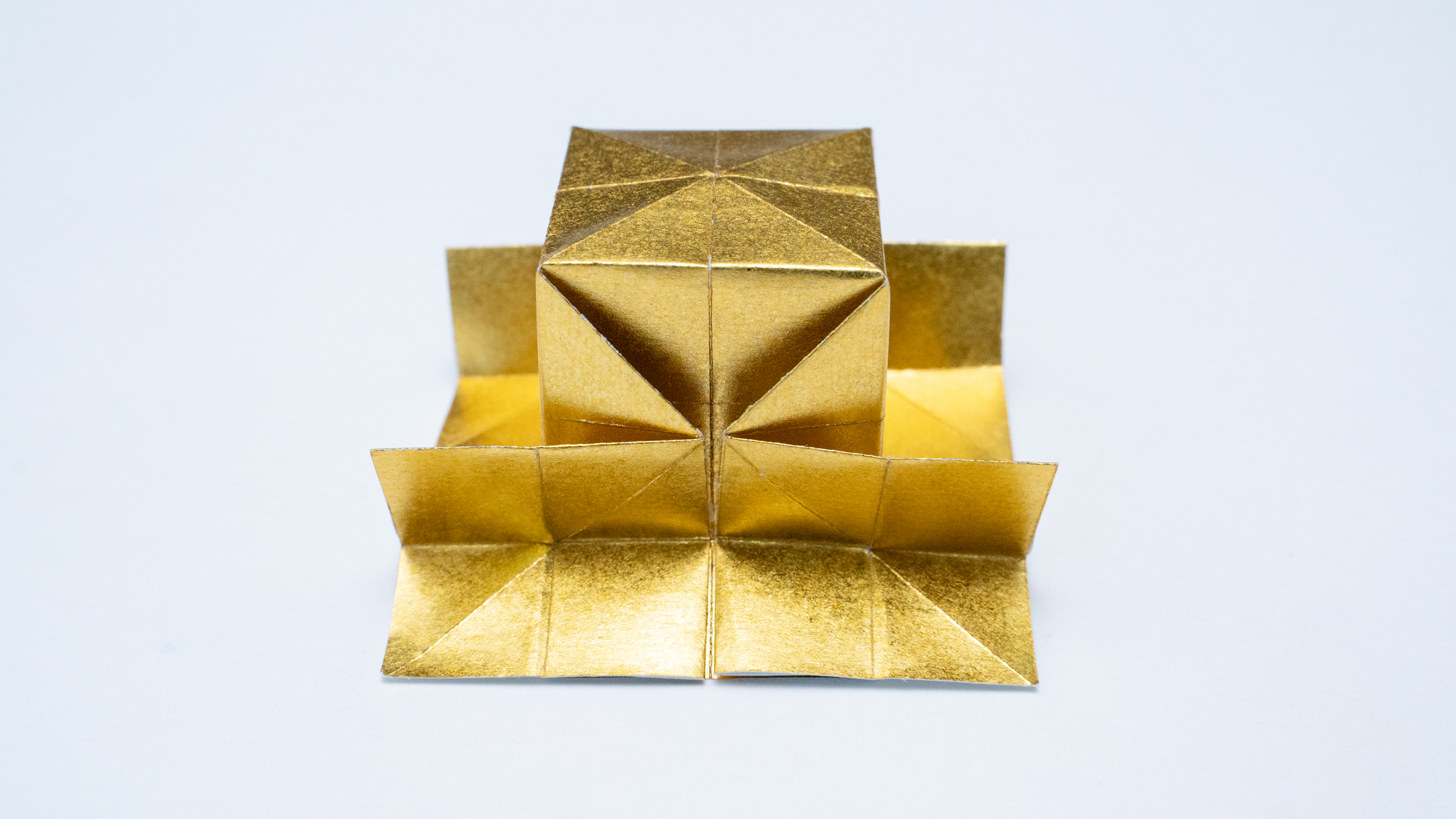
A cube with a band-like structure around its perimeter, serving as a structural isotope of the basic cube.
Because its volumetric structure appears on the surface and remains movable, it can be easily transformed into other shapes.
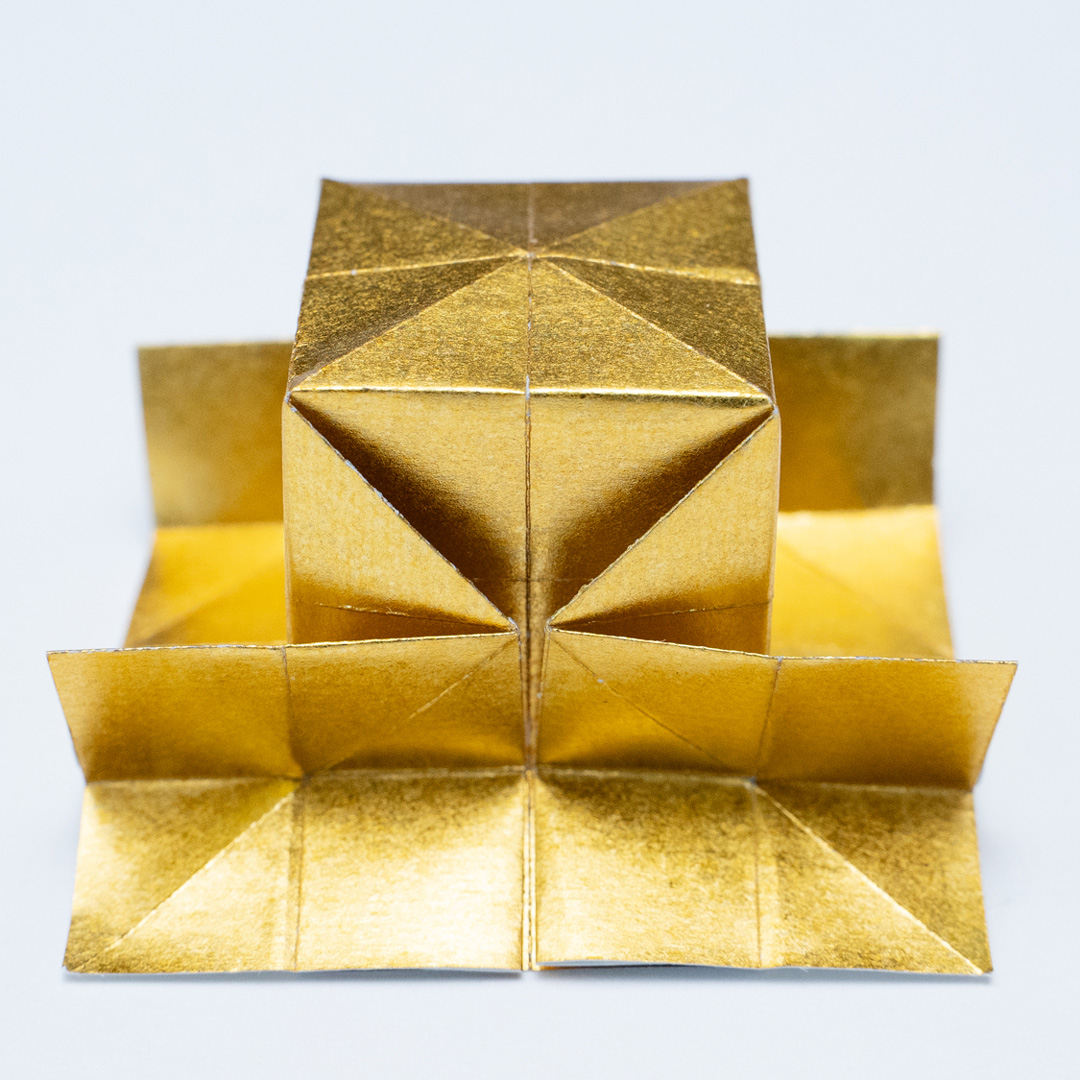
Cube
A cube with a band-like structure around its perimeter, serving as a structural isotope of the basic cube. Because its volumetric structure appears on the surface and remains movable, it can be easily transformed into other shapes.
Inverted Cube
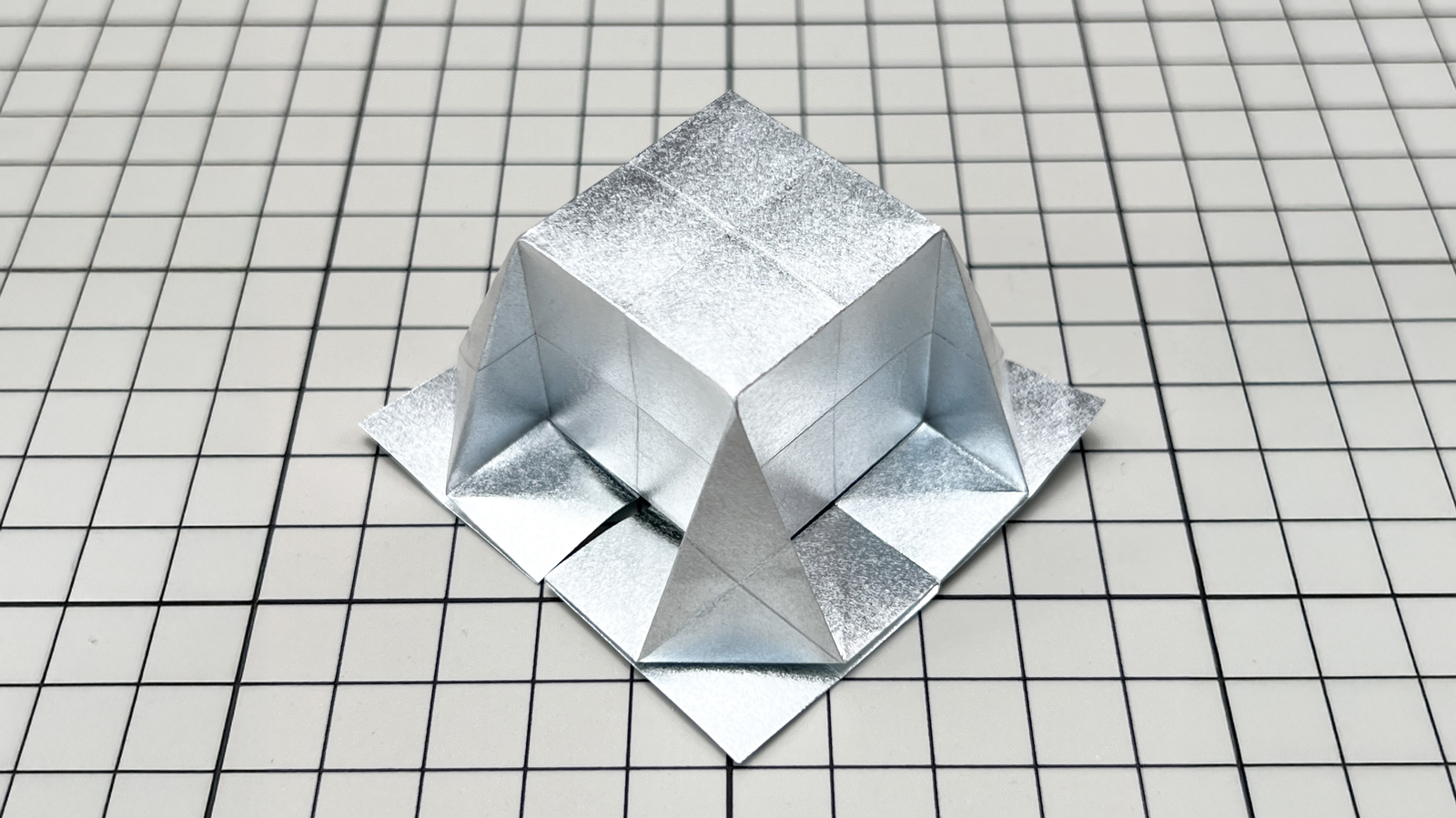
A structure created by turning the internal structure of the basic cube outward.
It allows for decorative expressions in which triangular prisms surround the cube.
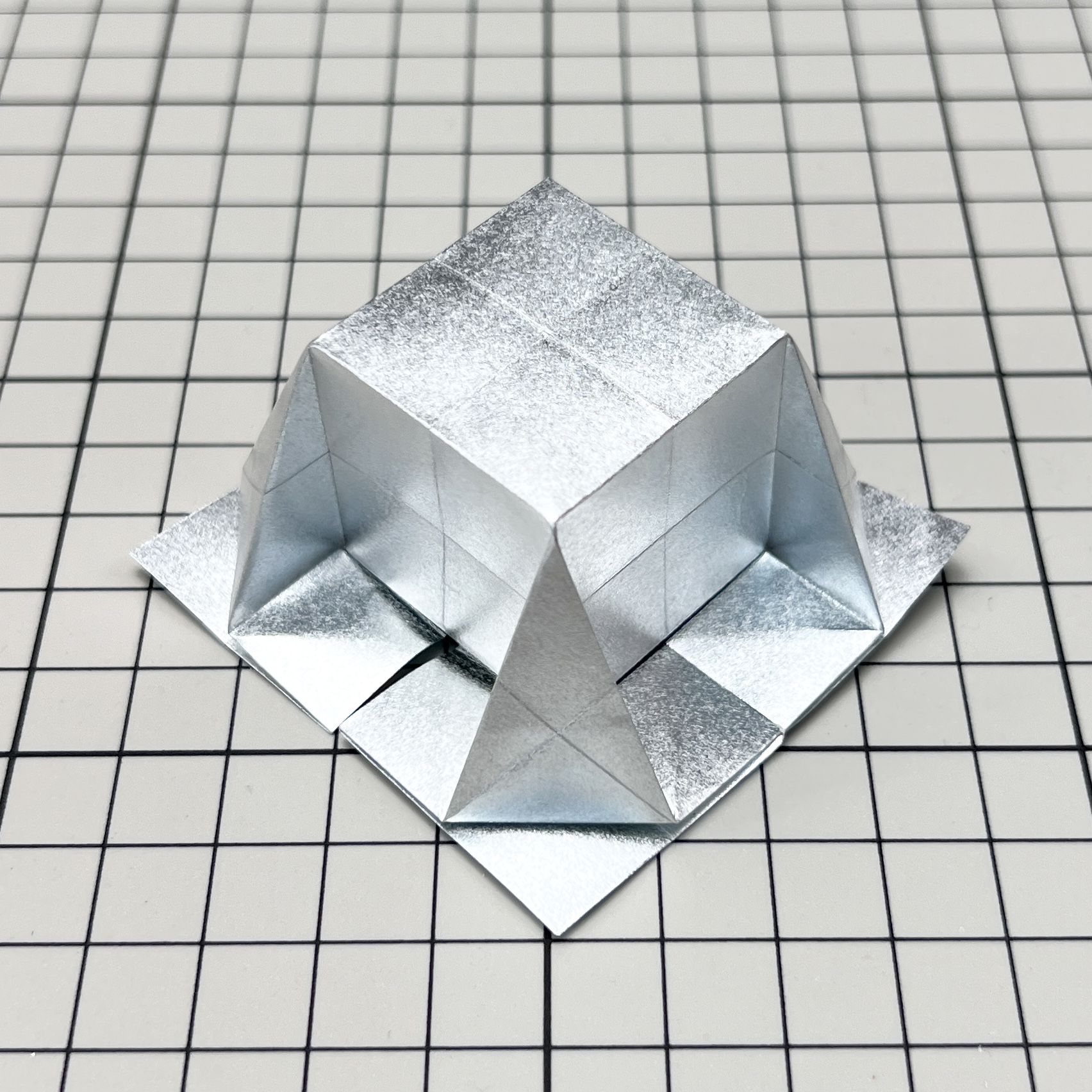
Inverted Cube
A structure created by turning the internal structure of the basic cube outward. It allows for decorative expressions in which triangular prisms surround the cube.
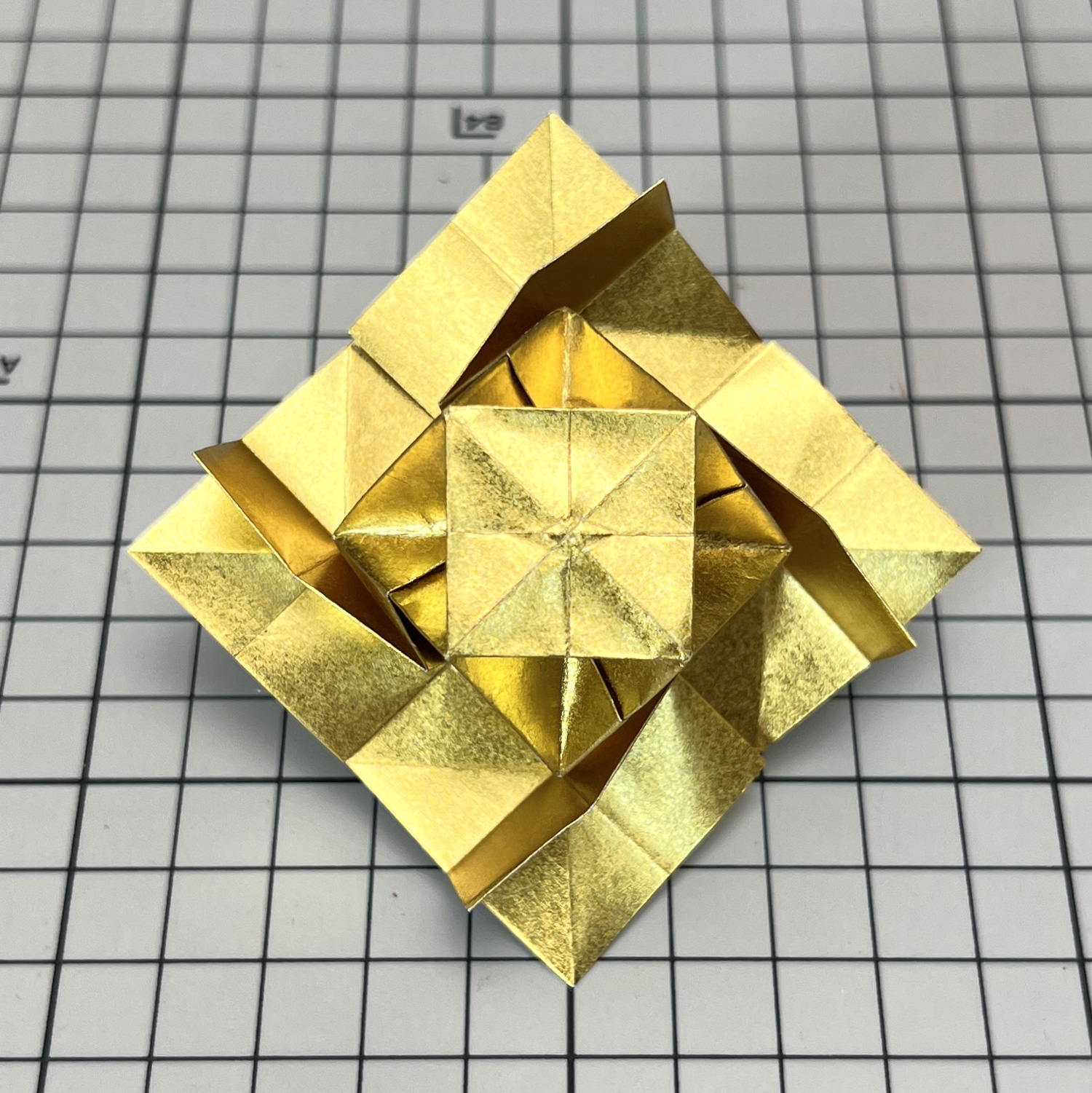
Truncated Cube
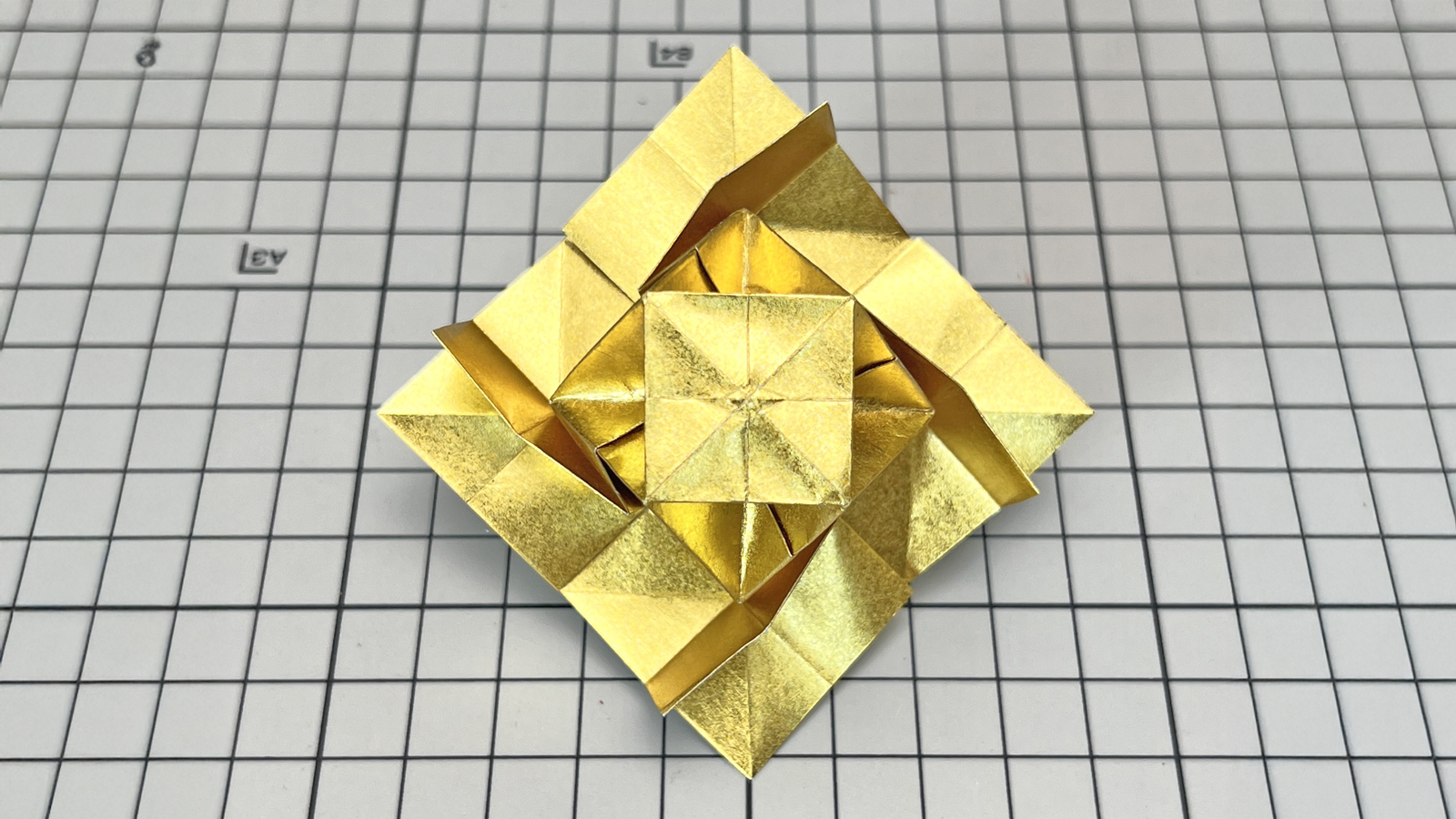
A structure resembling a banded cube with its vertices cut off.
It enables sharp, recessed expressions similar to cut glass.
Distorted Truncated Cube
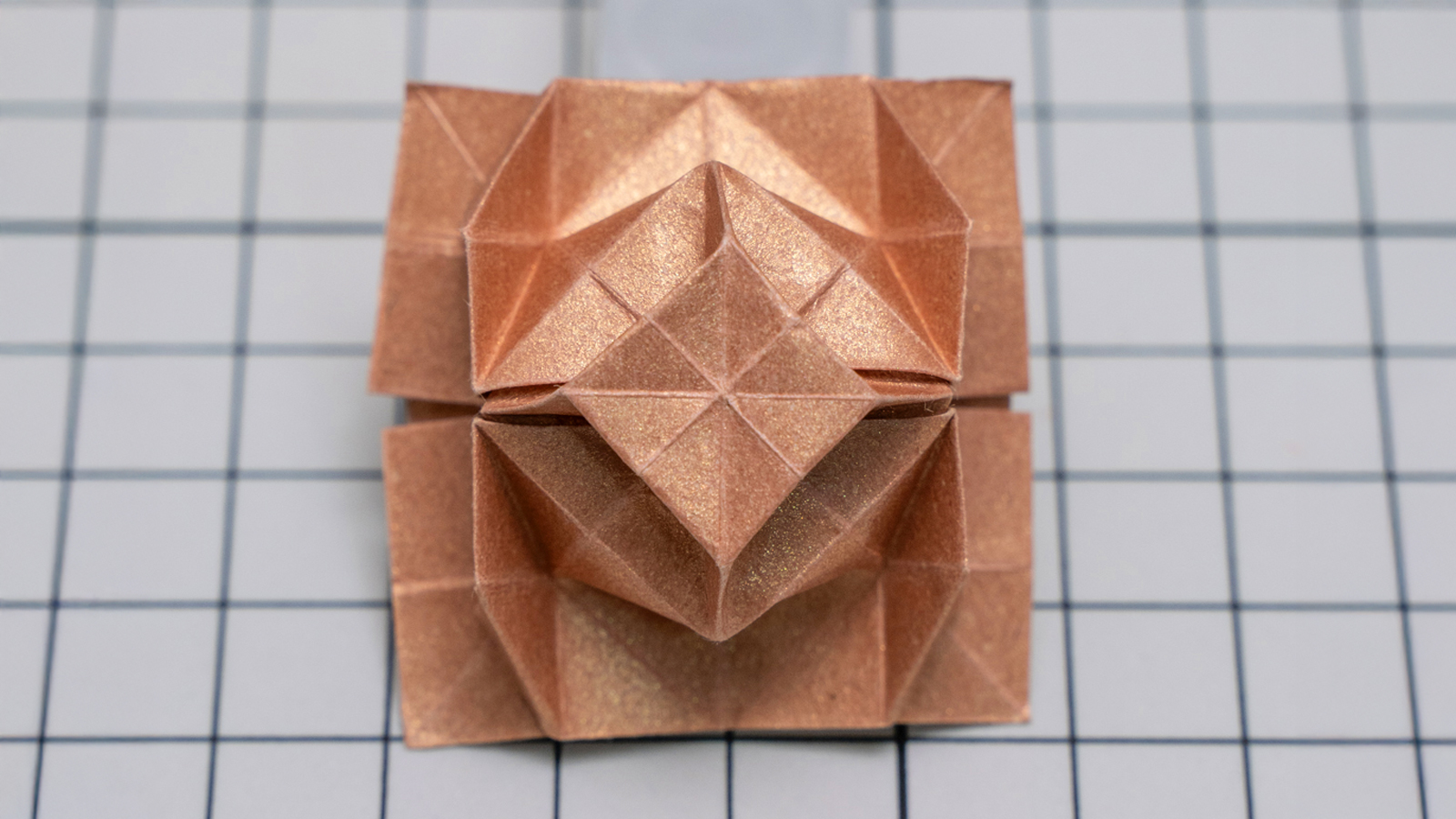
A structure in which vertices are cut off from a banded cube while introducing distortion to the faces.
It serves as a bridge to organic and biological forms.
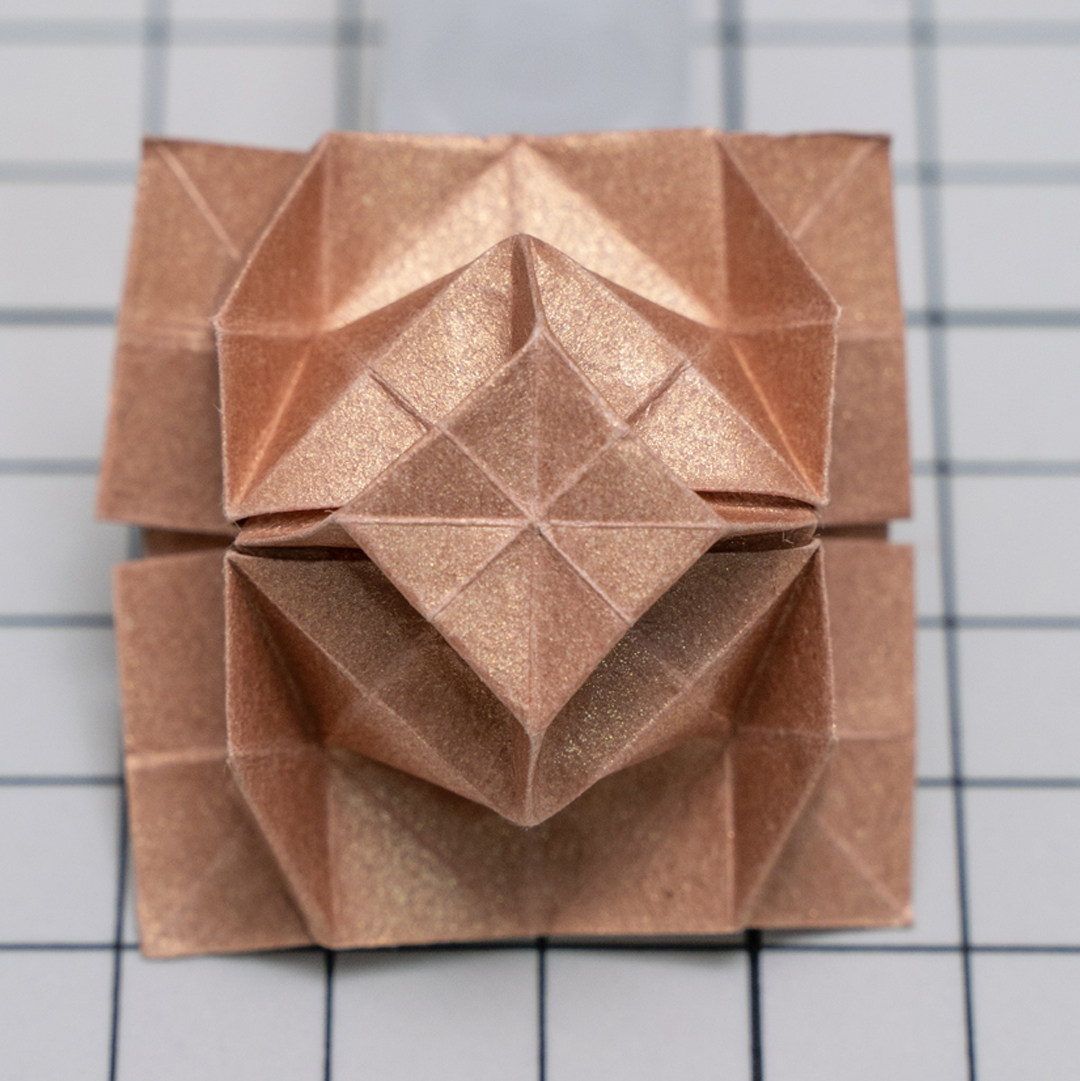
Distorted Truncated Cube
A structure in which vertices are cut off from a banded cube while introducing distortion to the faces. It serves as a bridge to organic and biological forms.
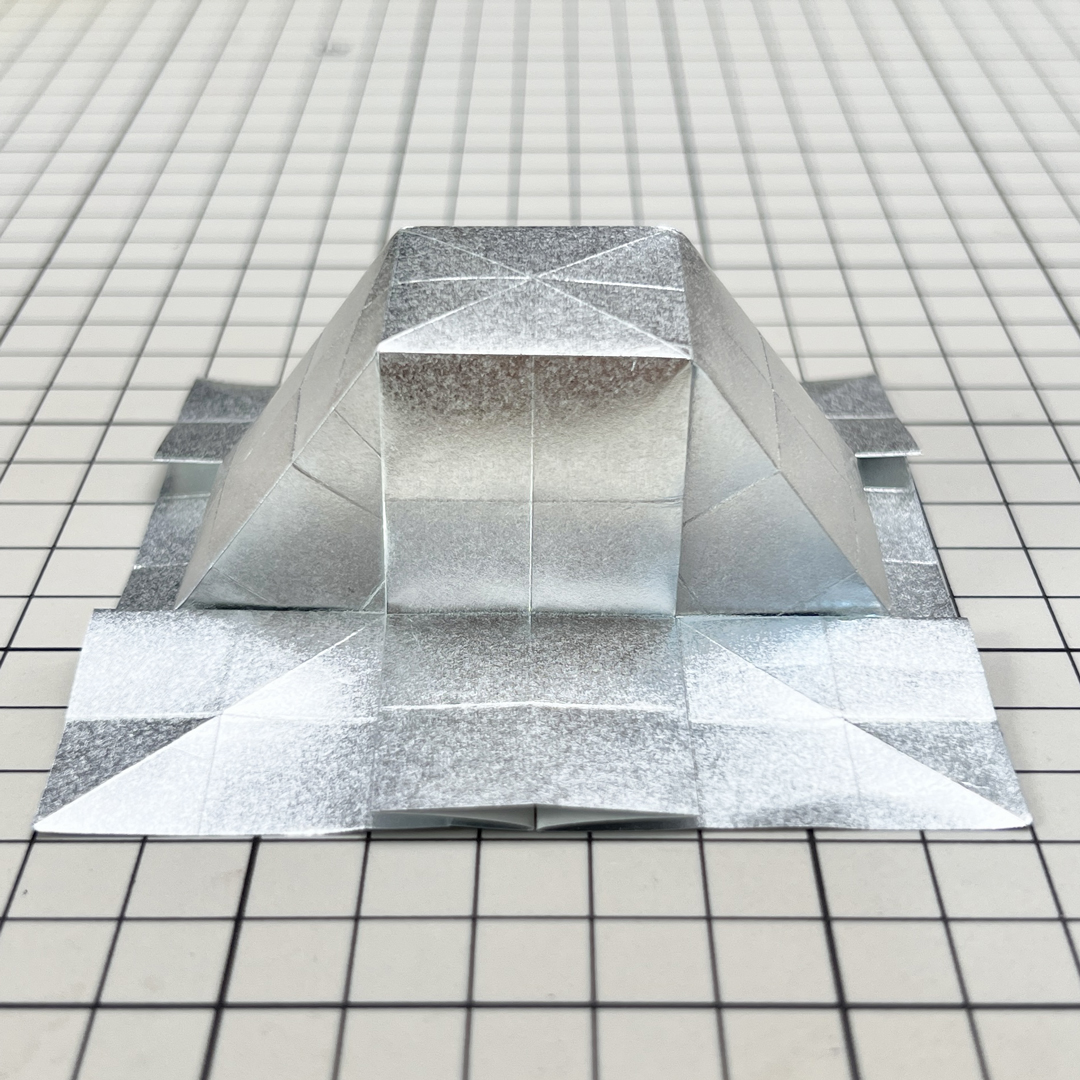
Trapezoidal Deformed Cube
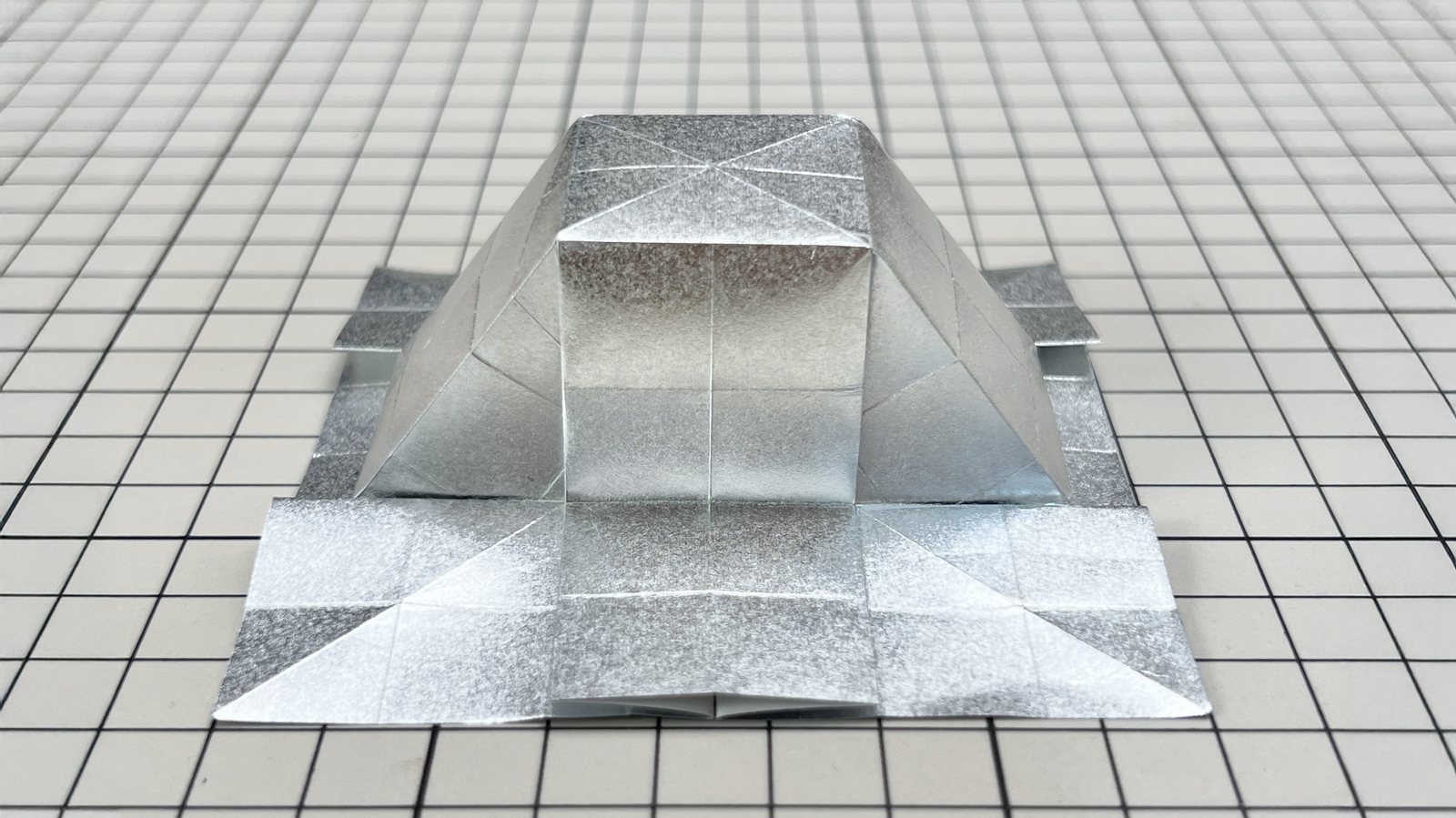
A structure formed by altering the angles of the cube’s side faces into trapezoidal shapes.
It is well suited for designs with directionality and inclination.
Diagonal Grid Cube
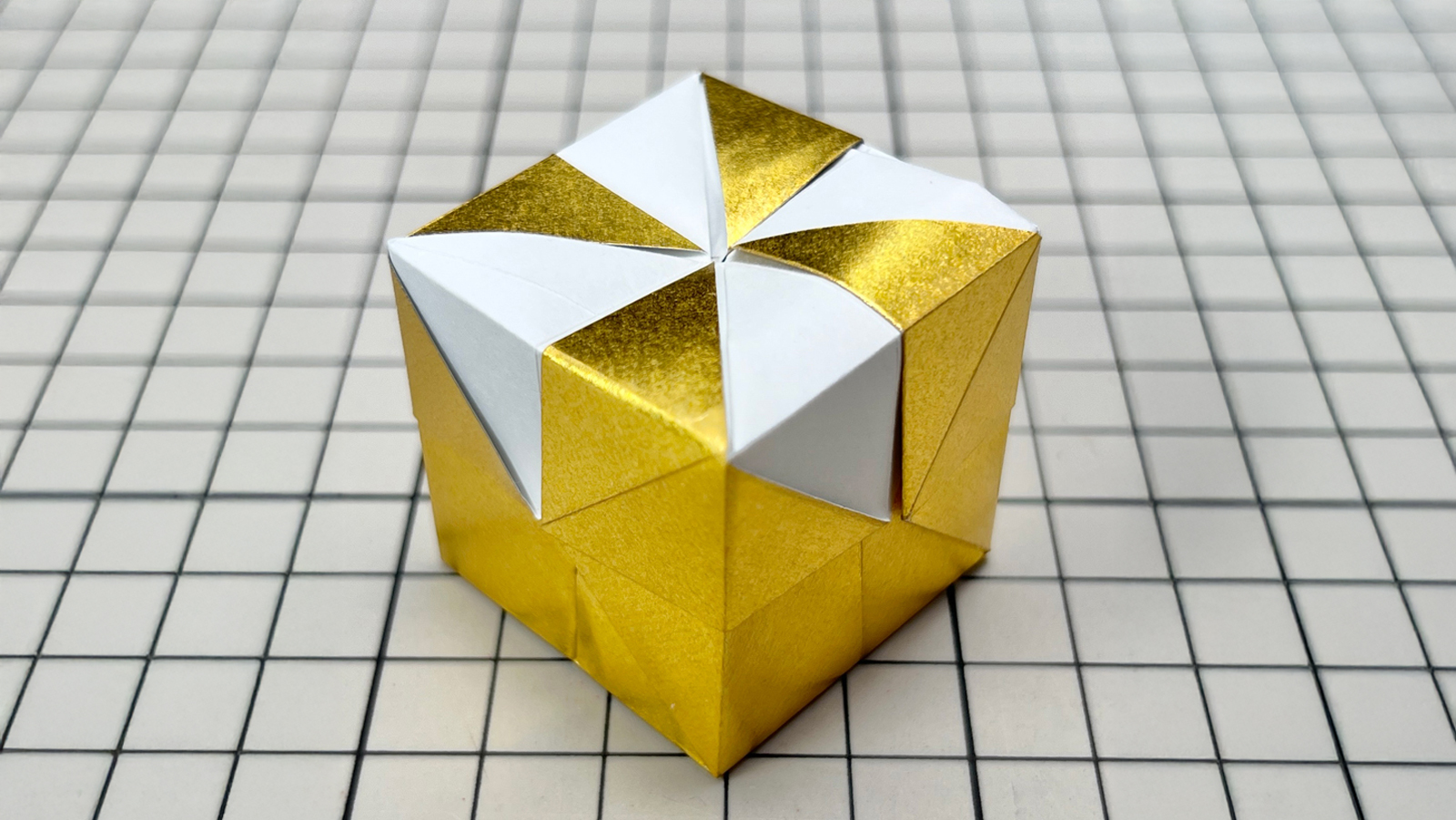
A cube constructed using a diagonal grid .
Patterns appear on the top surface, forming a complete cube.
By changing the number of grid divisions, its height can be adjusted to create a rectangular prism.
It combines easily with other structures and is well suited for creating plant-like forms.
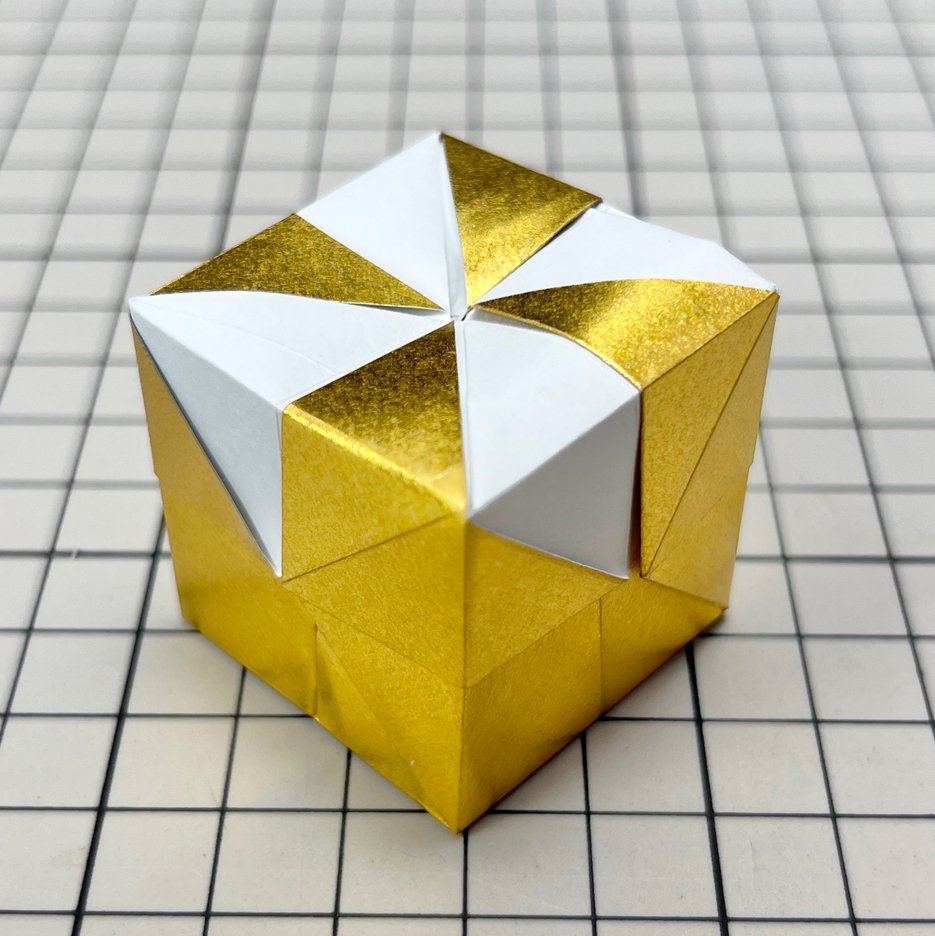
Diagonal Grid Cube
A cube constructed using a grid composed of lines parallel to the diagonal direction (45-degree direction), rather than to the edges of the paper. A defining feature of this structure is that the reverse side of the paper appears on the top surface, creating a visible pattern.
Truncated Cube (Perforated)
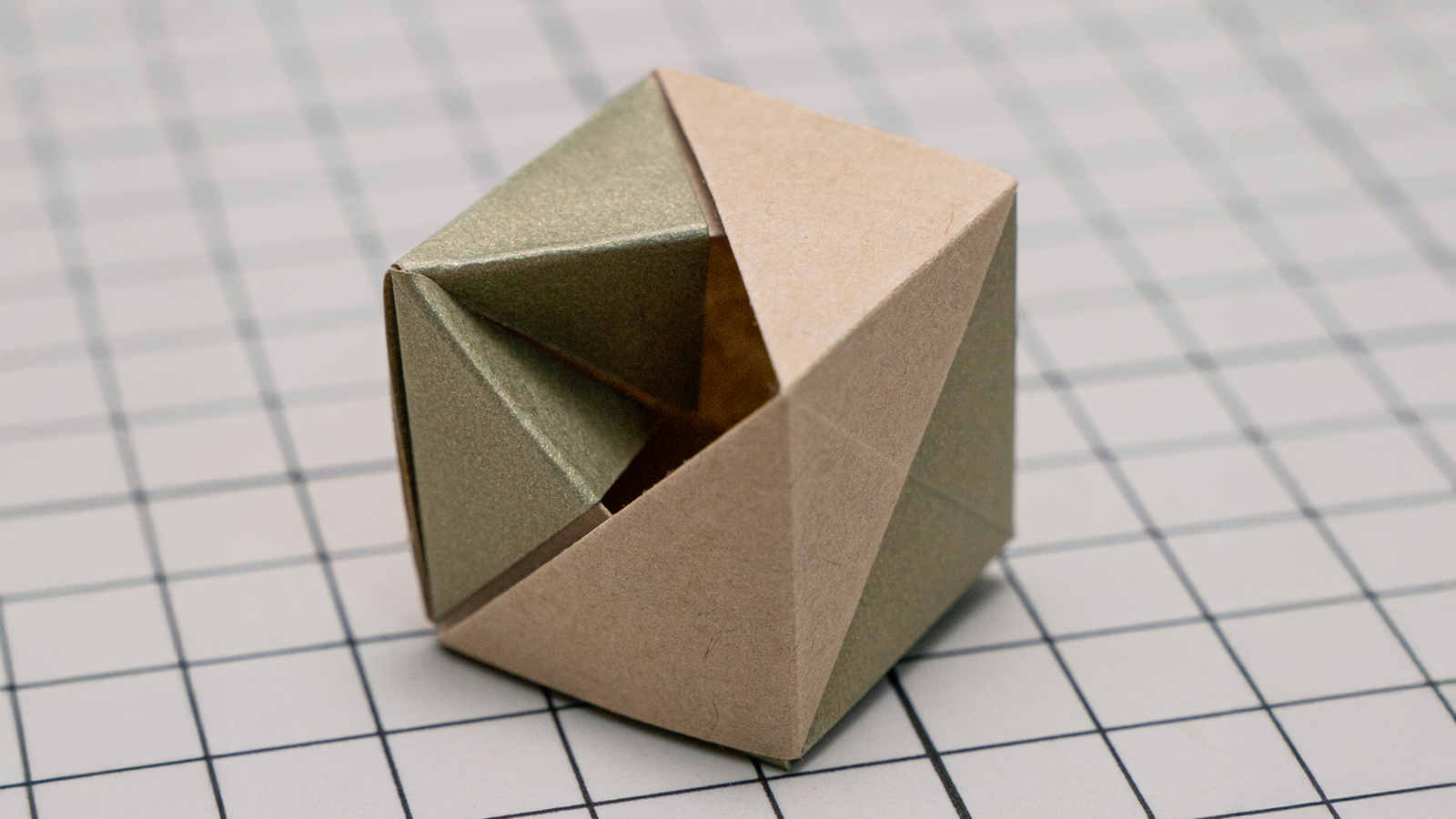
A cube constructed using a diagonal grid .
Patterns appear across all surfaces, and openings are formed in certain areas.
It combines easily with other structures and is well suited for creating plant-like forms.
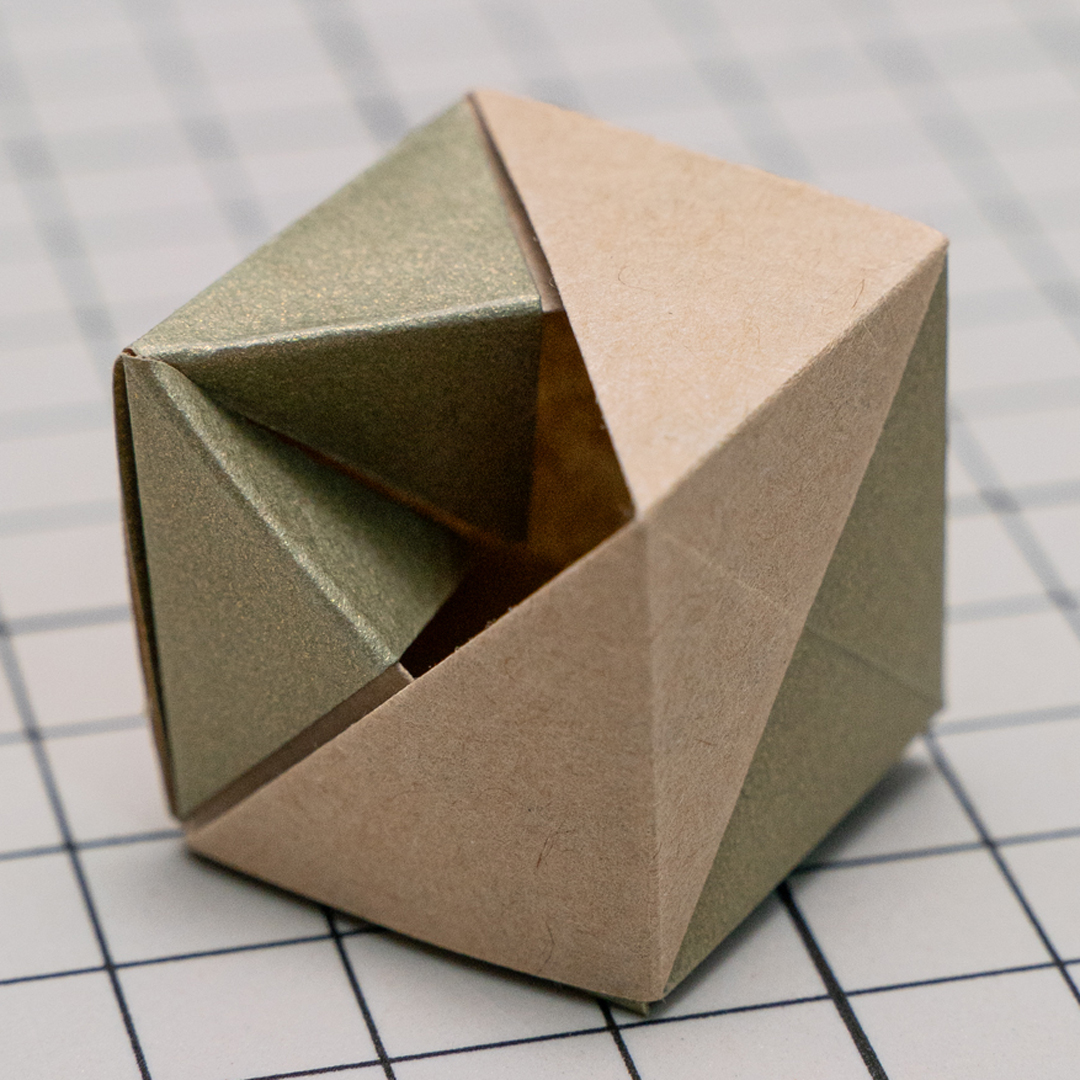
Corner-Truncated Cube
A cube constructed using a diagonal grid. Patterns appear across all surfaces, and openings are formed in certain areas. It combines easily with other structures, making it well suited for creating forms such as plants.
3. Pyramid and Polyhedral Components
Aggregated Square Pyramid
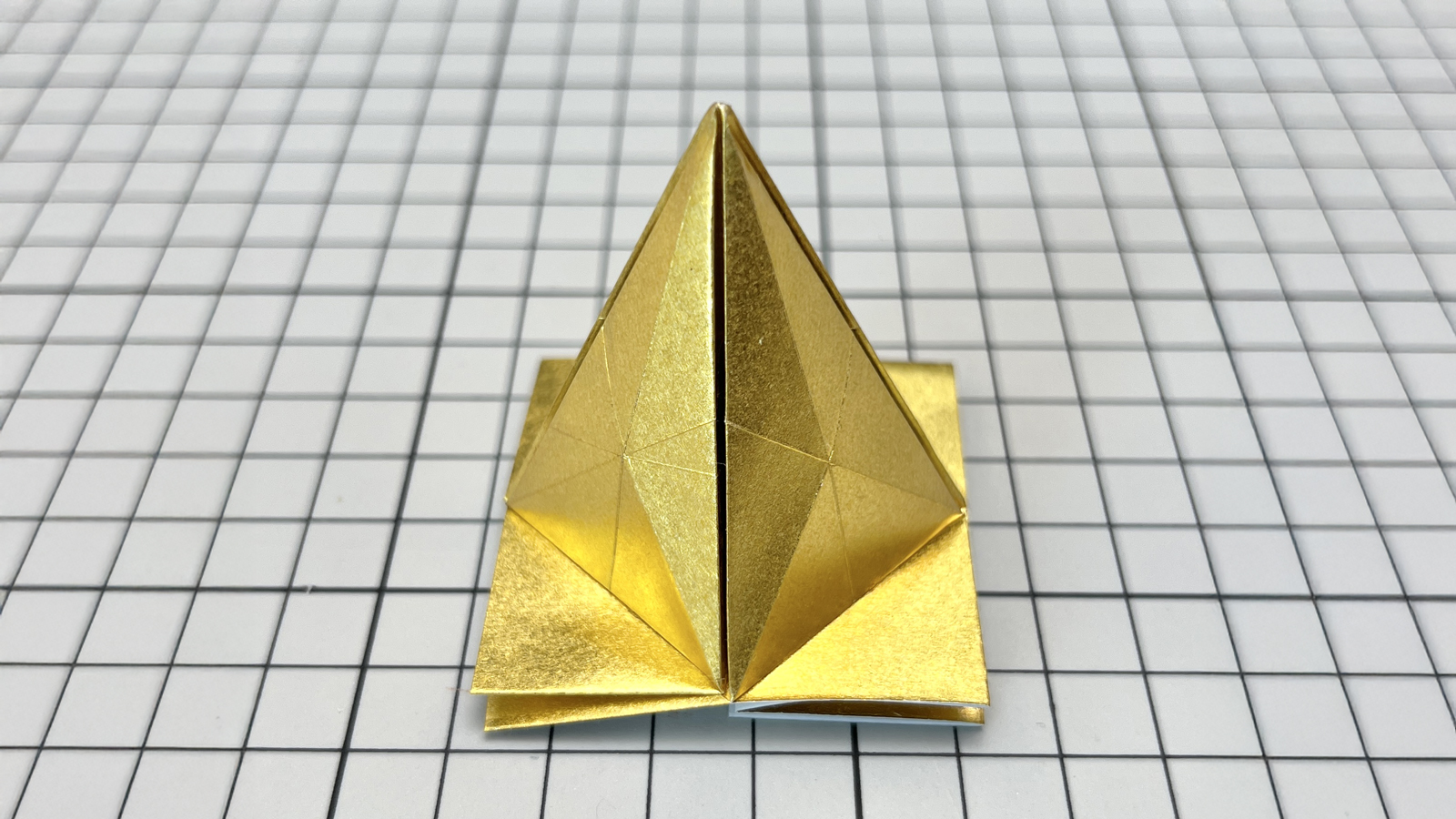
A square pyramid with a sharply pointed apex.
It can be constructed by combining four triangular pyramid units using a twisting fold.
A frame-like structure forms inside, giving it high structural strength.
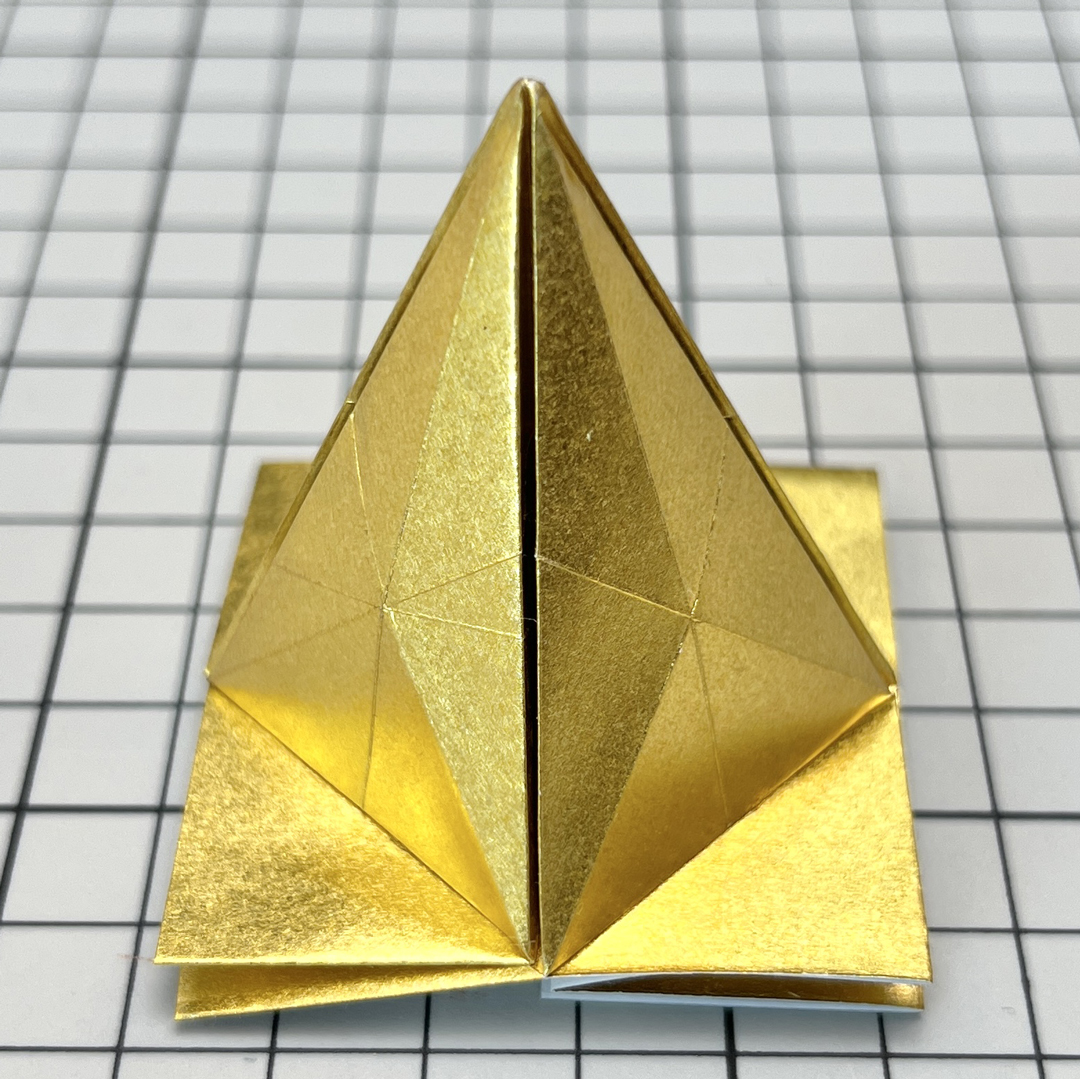
Composite Square Pyramid
A square pyramid with a sharply pointed apex. It can be constructed by combining four triangular pyramid units using a twisting fold. A frame-like structure forms inside the shape, giving it high structural strength.
Hollow Square Pyramid
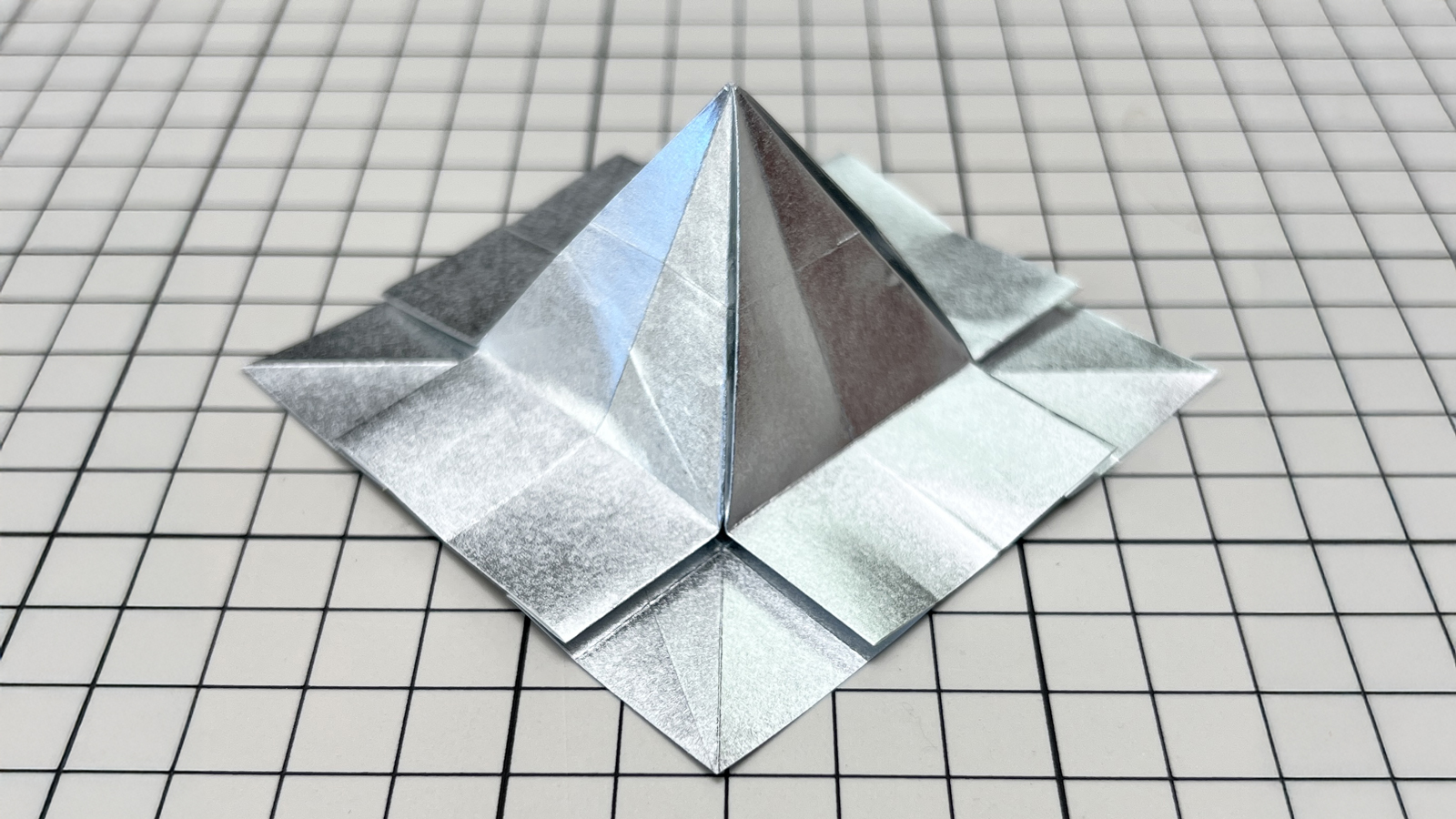
A square pyramid with a hollow interior.
Its height can be adjusted by changing the amount of paper used.
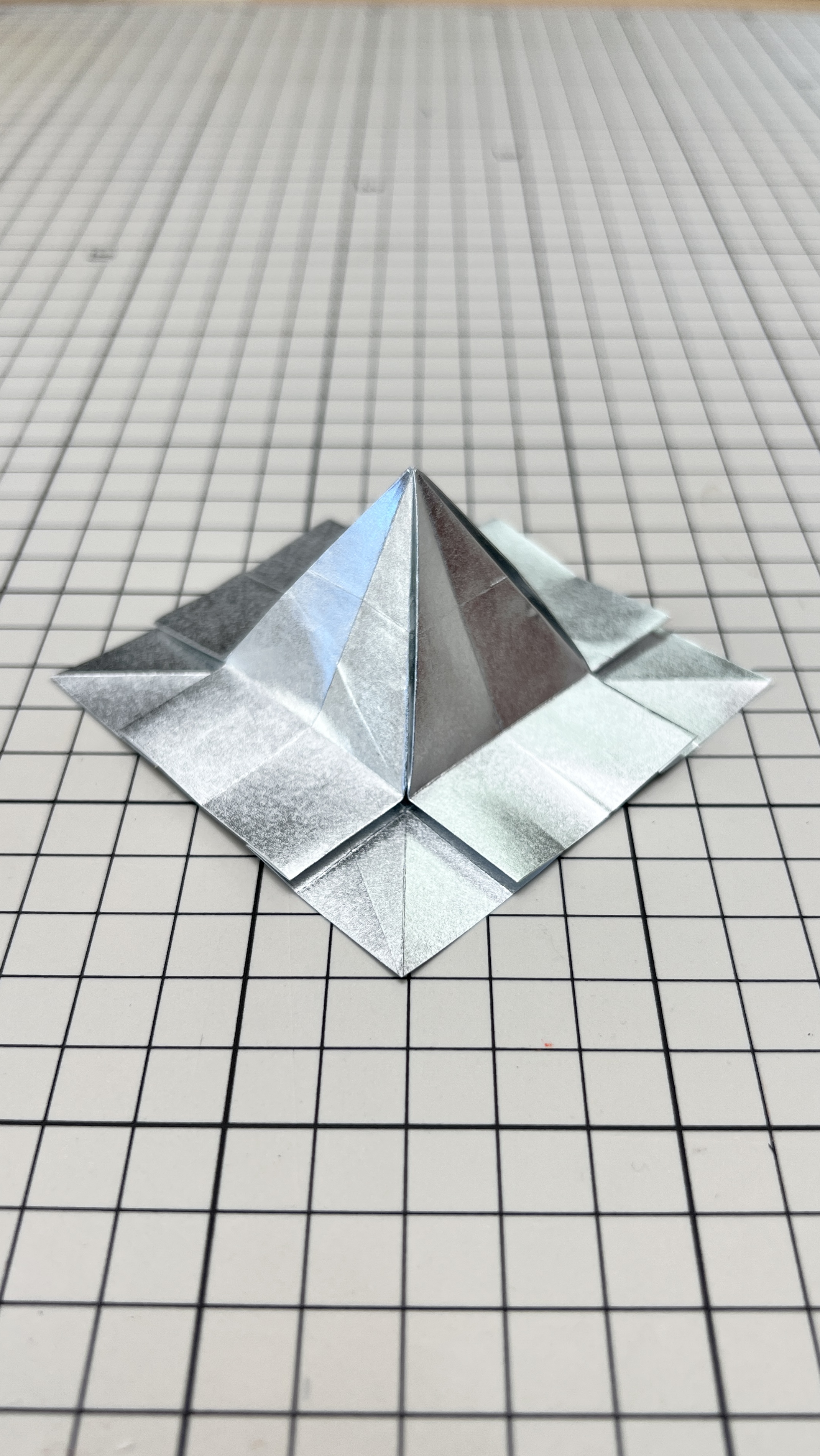
Hollow Square Pyramid
A square pyramid with a hollow interior. Its height can be adjusted by changing the amount of paper used.
Folded Triangular Pyramid
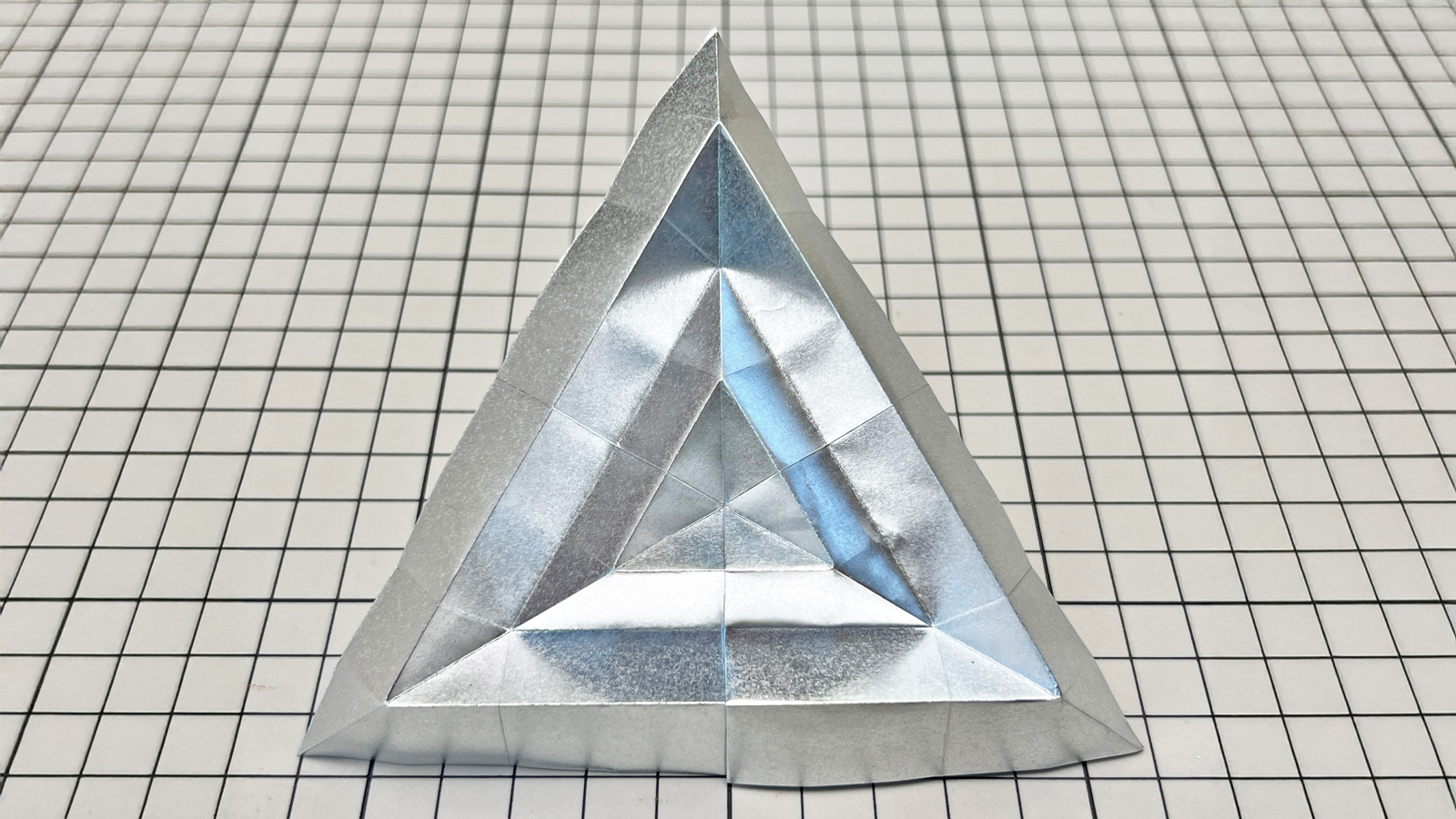
A structure formed by vertically compressing an obtuse triangular pyramid using a three-dimensional sink-fold technique.
The three-dimensional sink fold becomes a locked fold, resulting in a stable structure.
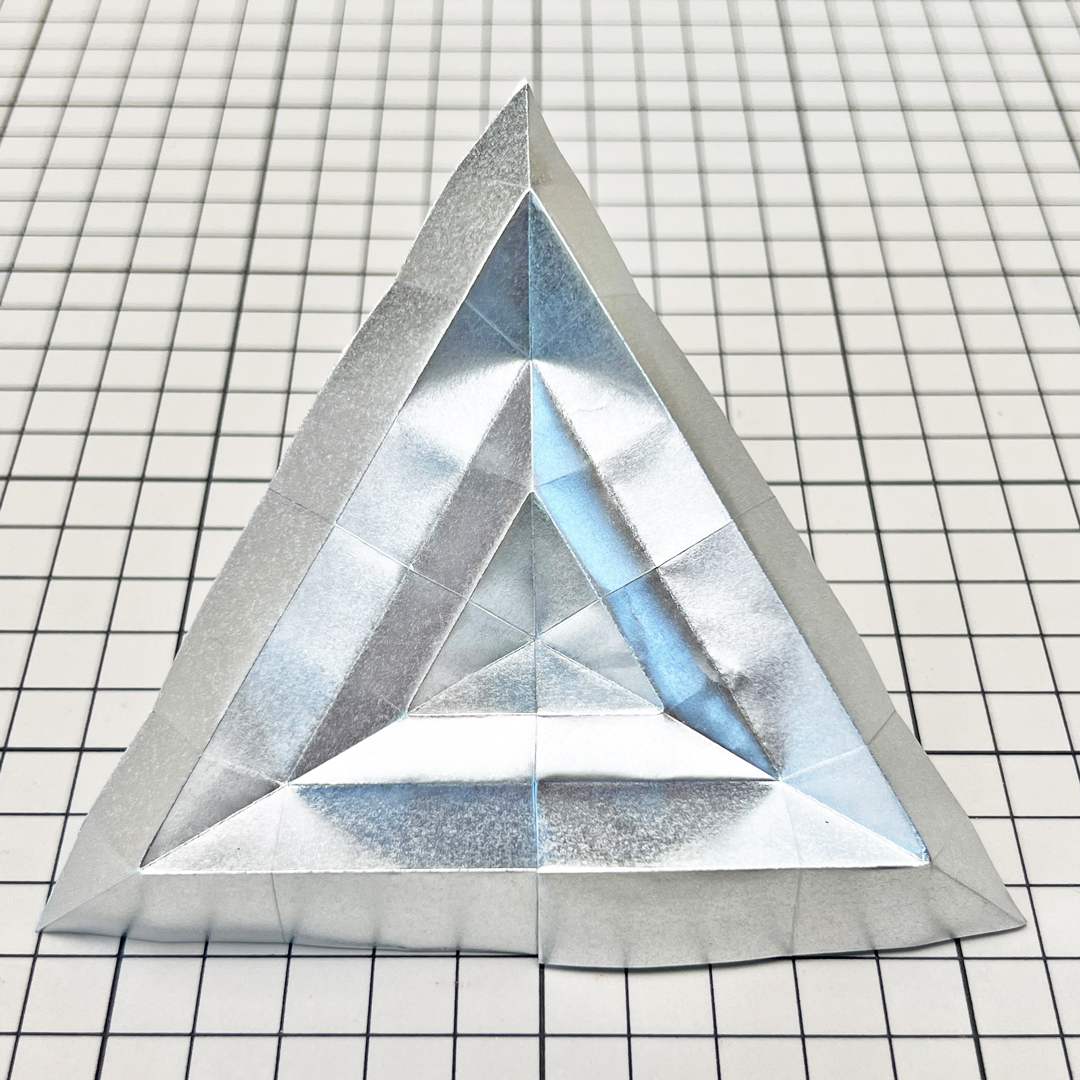
Collapsible Triangular Pyramid
A structure formed by vertically compressing an obtuse triangular pyramid using a three-dimensional sink-fold technique. The three-dimensional sink fold becomes a locked fold, resulting in a stable structure.
Asymmetric Triangular Pyramid
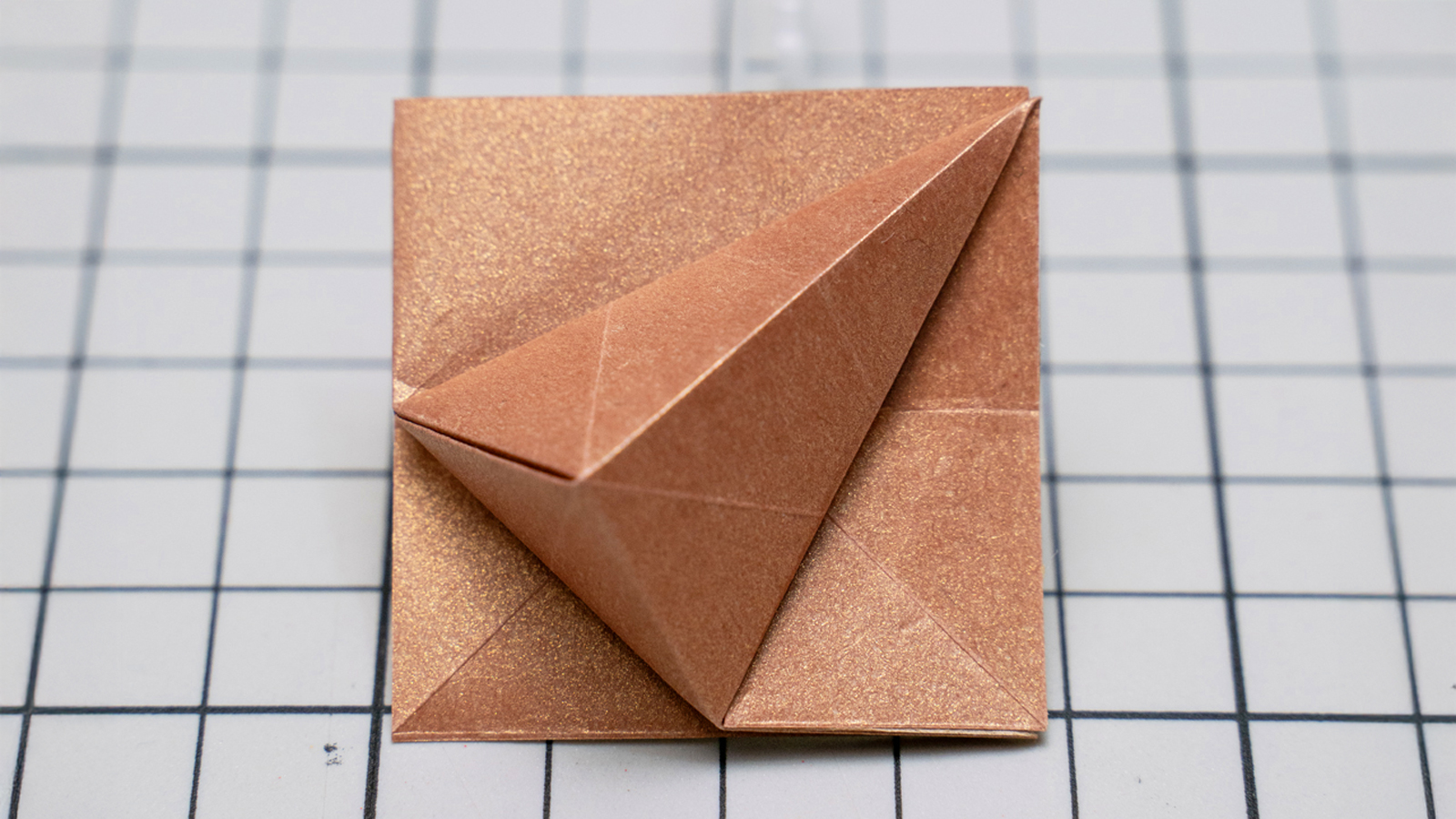
A triangular pyramid formed by deforming an obtuse triangular pyramid using a three-dimensional twist fold .
Its defining feature is a left–right asymmetric structure.
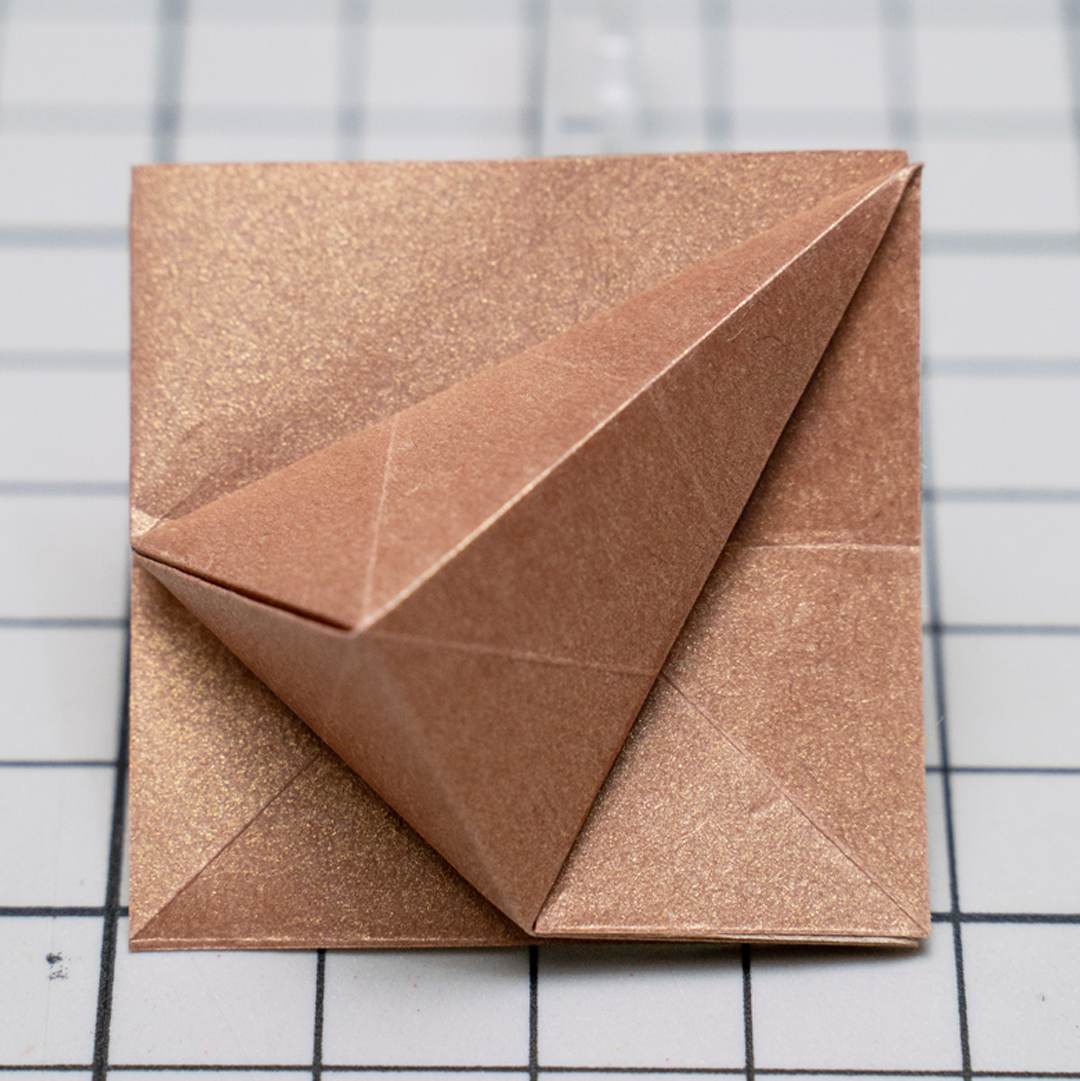
Asymmetric Triangular Pyramid
A triangular pyramid formed by deforming an obtuse triangular pyramid using a three-dimensional twisting fold. Its defining feature is a left–right asymmetric structure.
Octagonal Pyramid
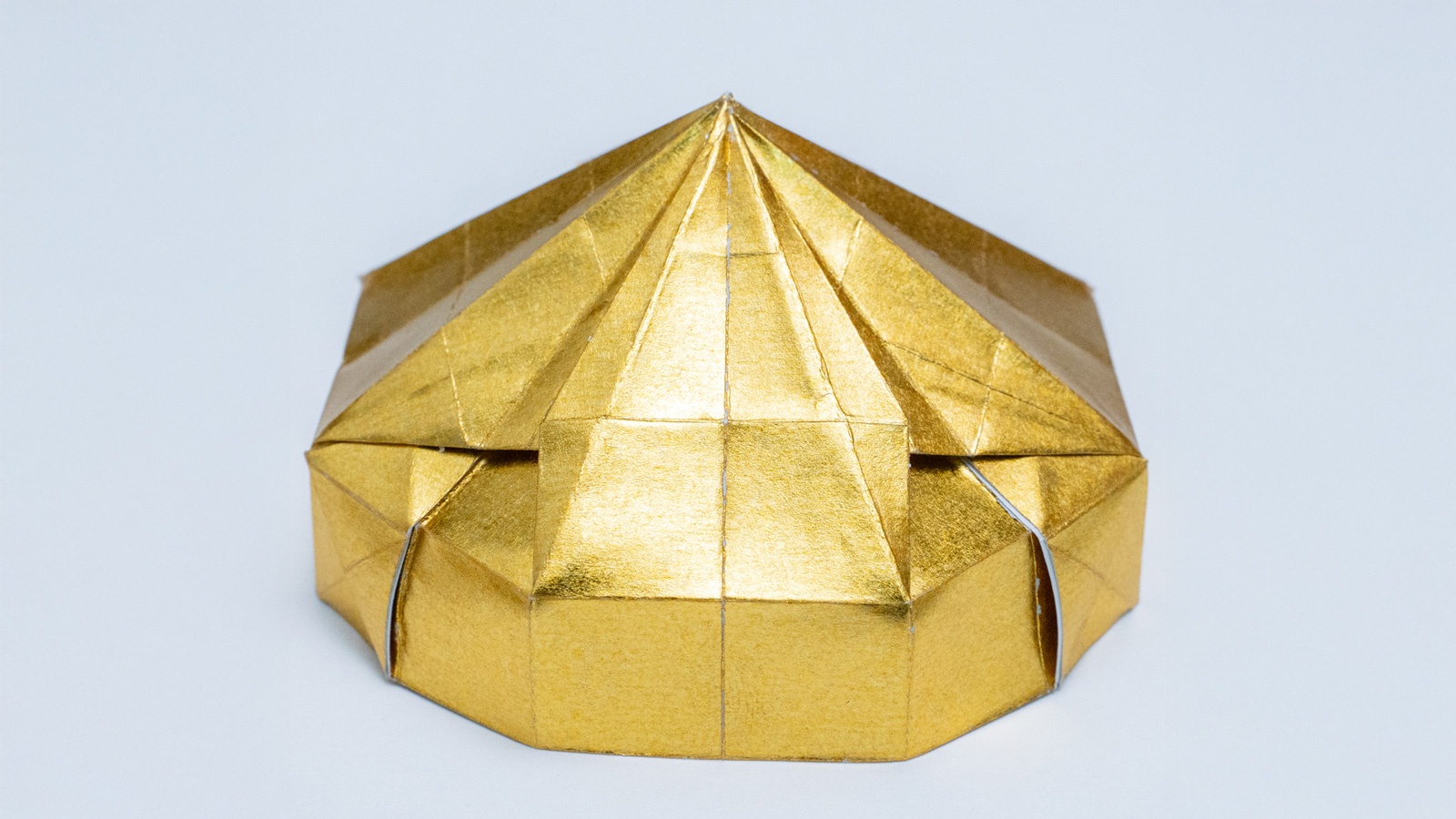
A hollow pyramidal structure with a regular octagonal base.
By adjusting the finishing folds, the apex angle can be narrowed to create a sharper tip.
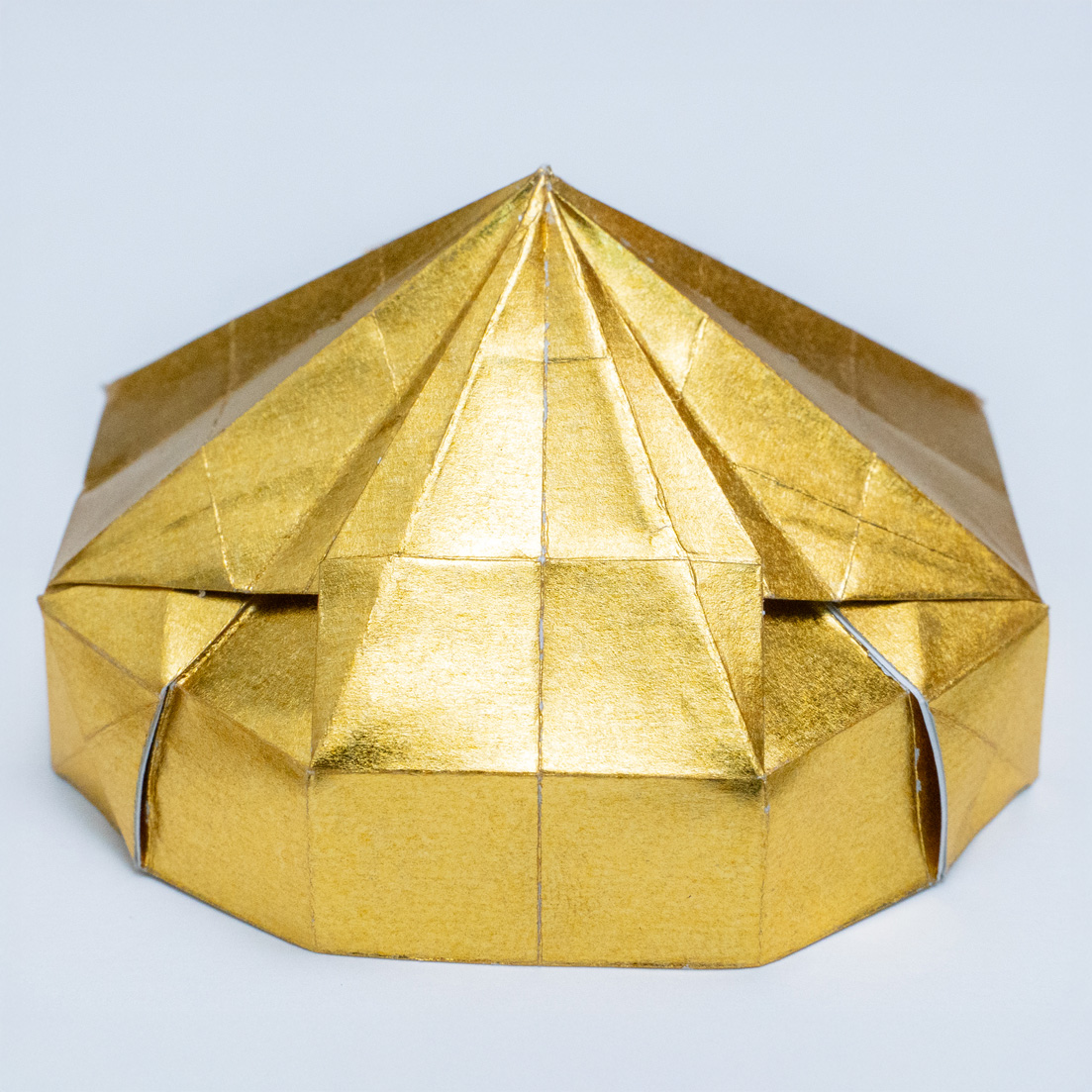
Octagonal Pyramid
A hollow pyramidal structure with a regular octagonal base. By adjusting the finishing folds, the apex angle can be narrowed, allowing the tip to become sharper.
4. Curved and Approximation Components
These components approximate curved surfaces using polygons rather than true curves.
Cuboctahedron
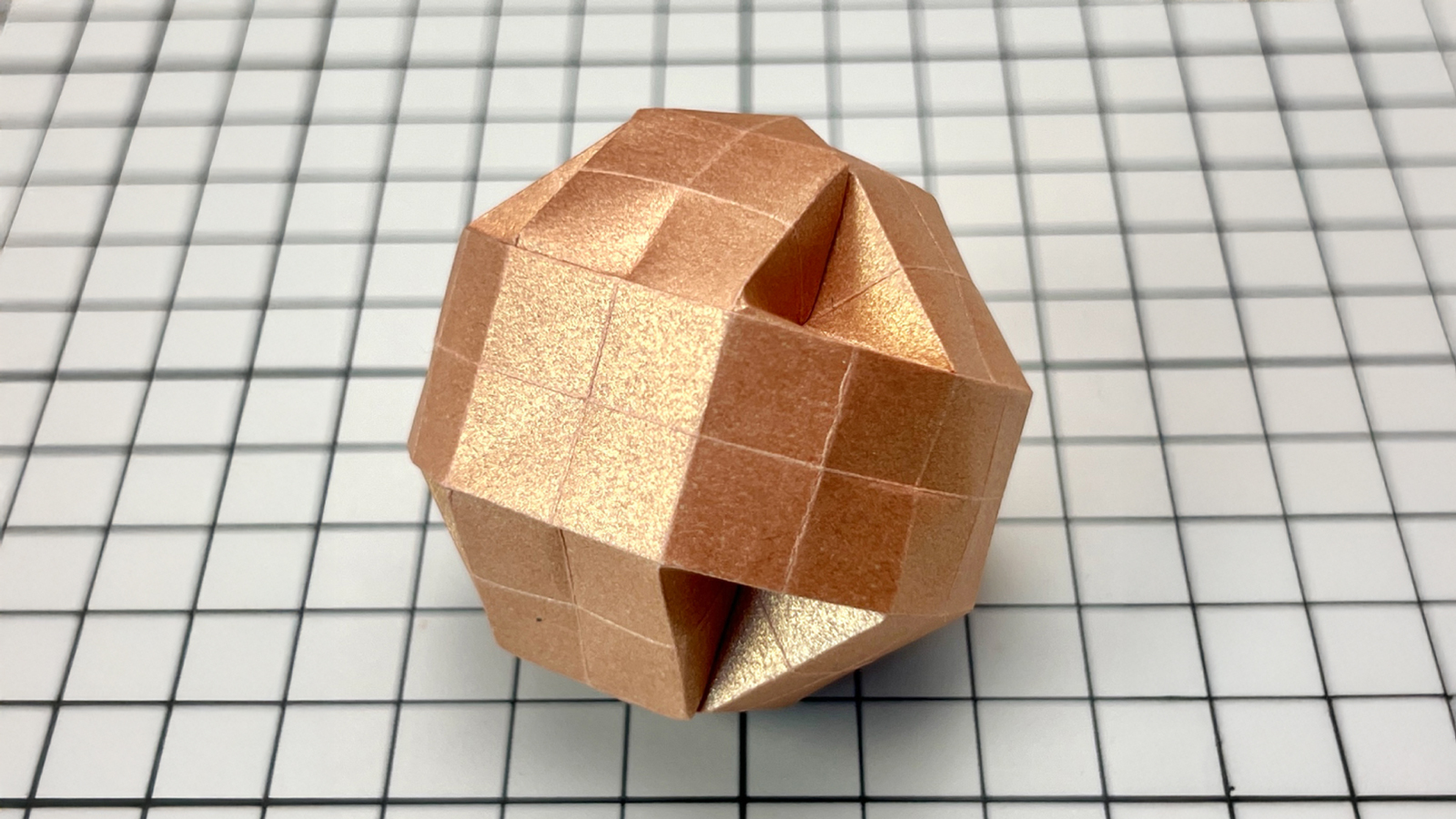
A cuboctahedron formed by applying three-dimensional sink folds to each vertex of a cube.
It is well suited for approximating spheres when creating structures such as light bulbs.
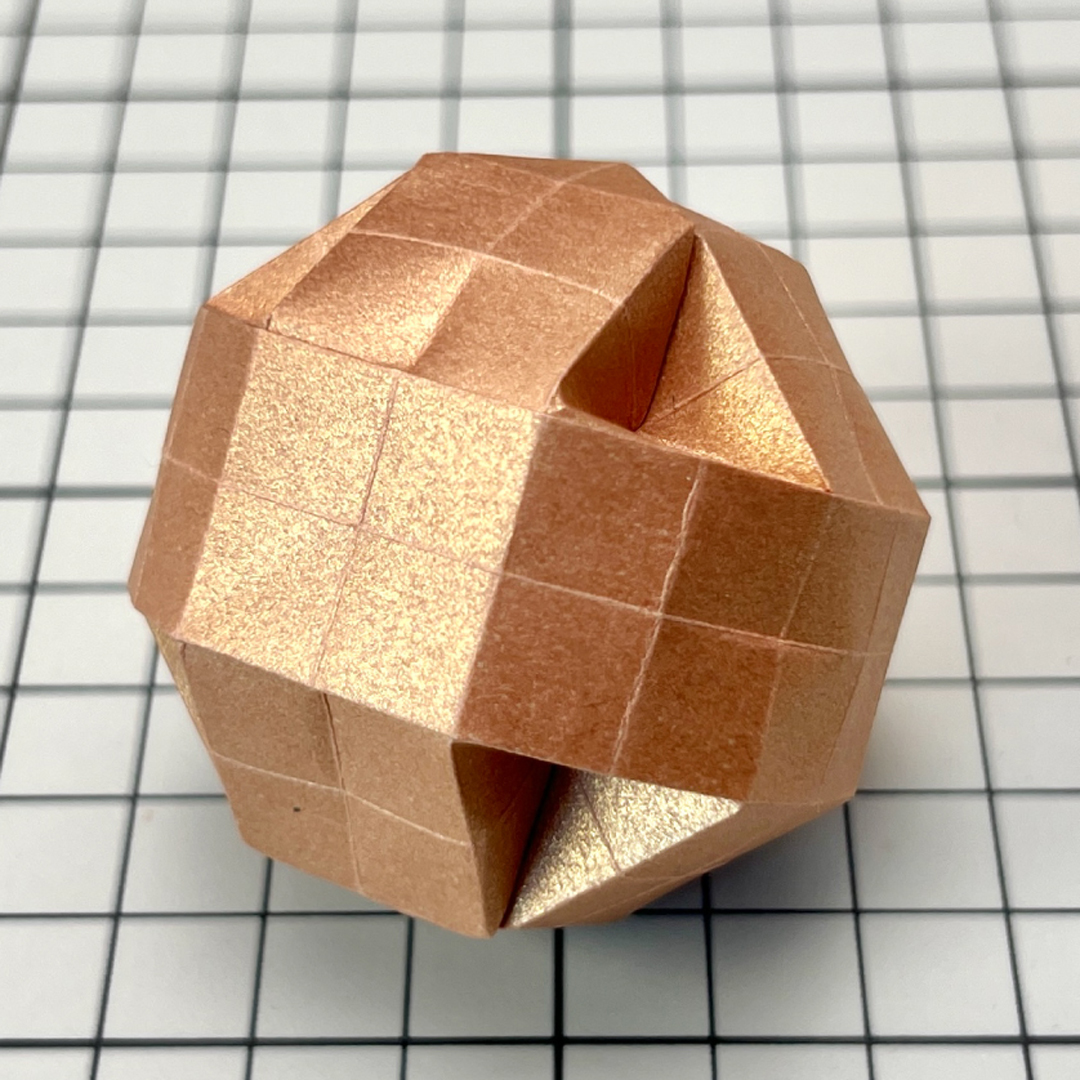
Cuboctahedron
A cuboctahedron formed by applying three-dimensional sink folds to each vertex of a cube. It is well suited for approximating a sphere when creating structures such as light bulbs.
Truncated Octagonal Pyramid
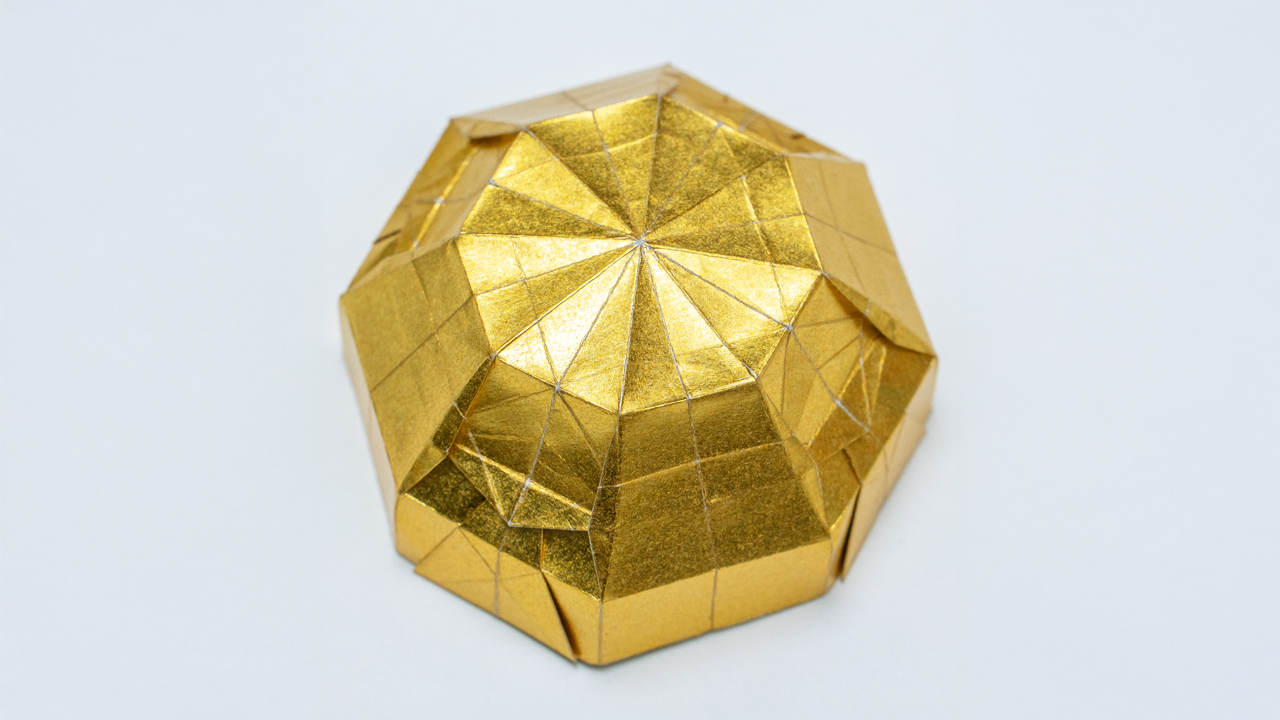
A bowl-shaped structure resembling an octagonal pyramid with its top cut off.
It is useful for approximating curved surfaces such as the cup of a wine glass or the caps of jellyfish and mushrooms.
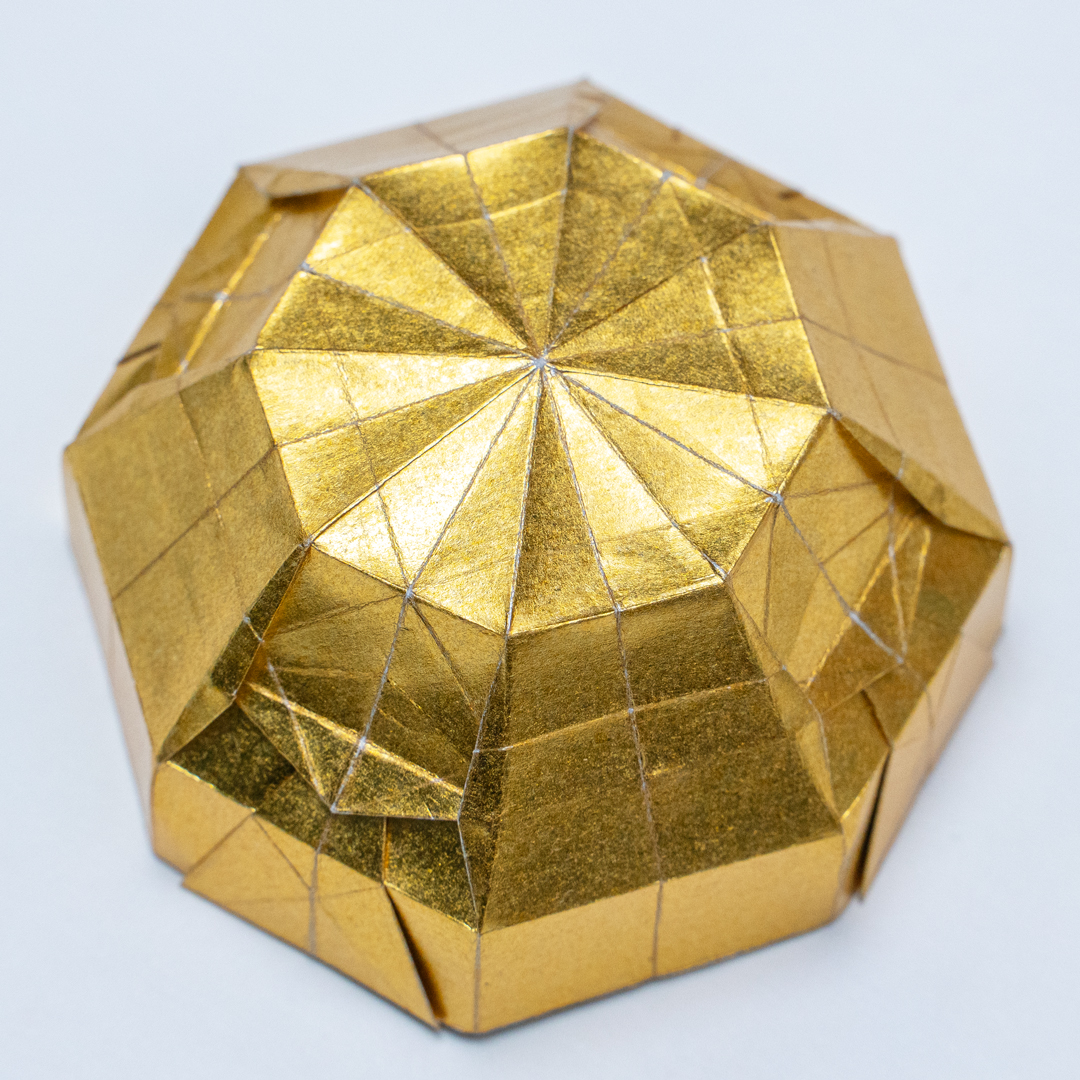
Truncated Octagonal Pyramid
A bowl-shaped structure resembling an octagonal pyramid with its top cut off. It is well suited for approximating curved surfaces such as the cup of a wine glass or the caps of jellyfish and mushrooms.
5. Composite Components
Structures created by combining multiple polygon components that are themselves composed of basic components.
Relief Cross
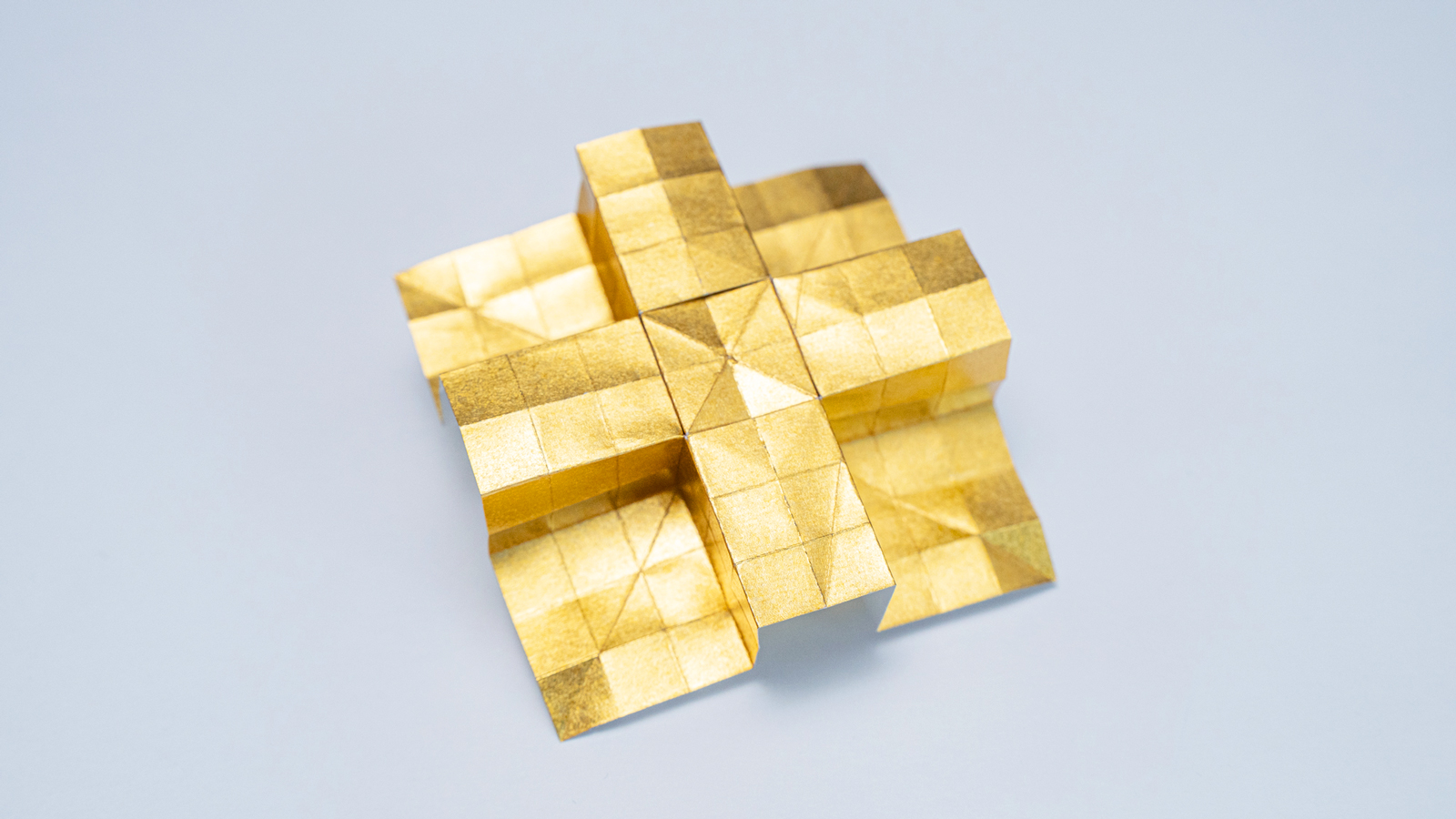
A relief cross structure.
A composite component created by combining banded cubes.
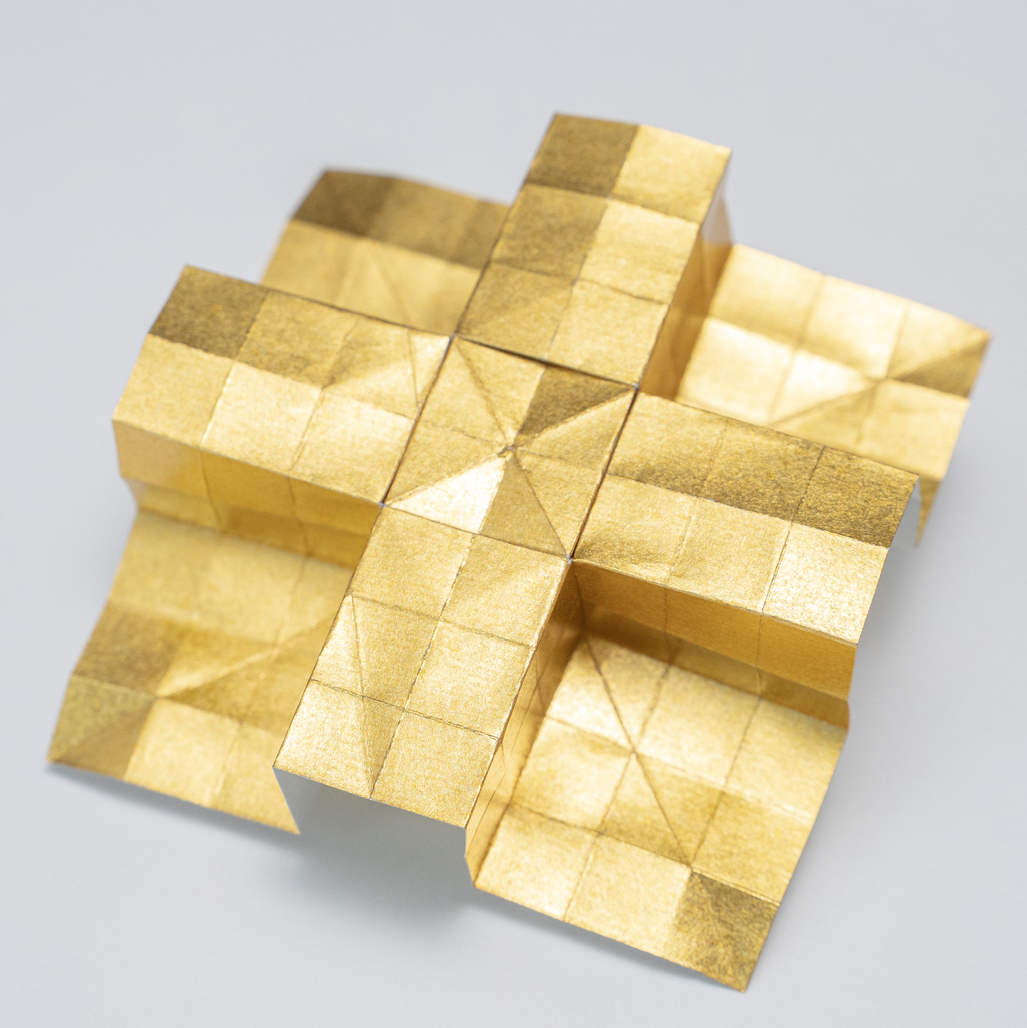
Relief Cross (Perforated)
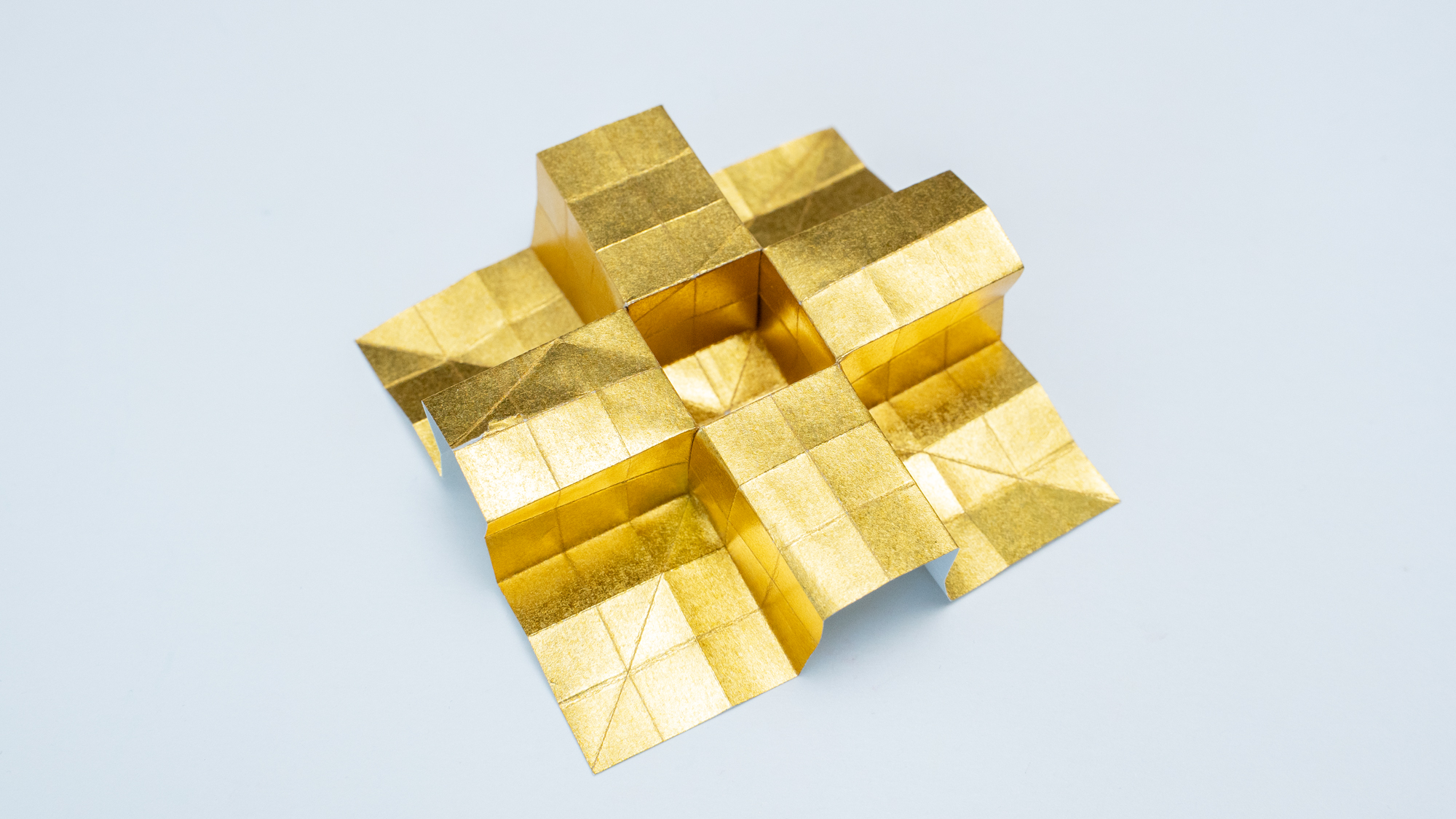
A relief cross structure with a recessed center.
A composite component created by combining banded cubes, with the central structure inverted to create the recess.
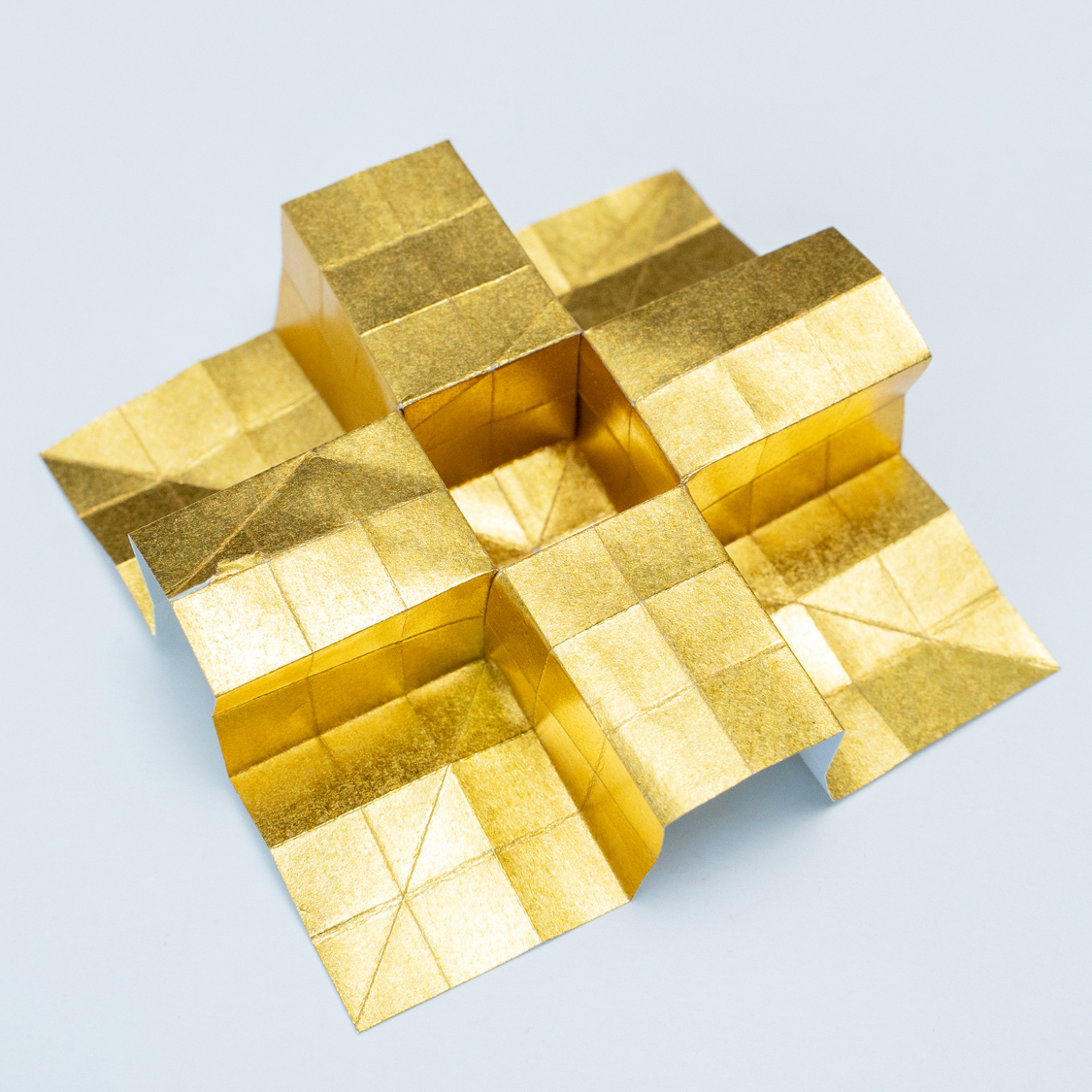
Relief Cross with a Recessed Center
A relief cross structure with a recessed center, created by combining multiple banded cube units.
Nested Cube
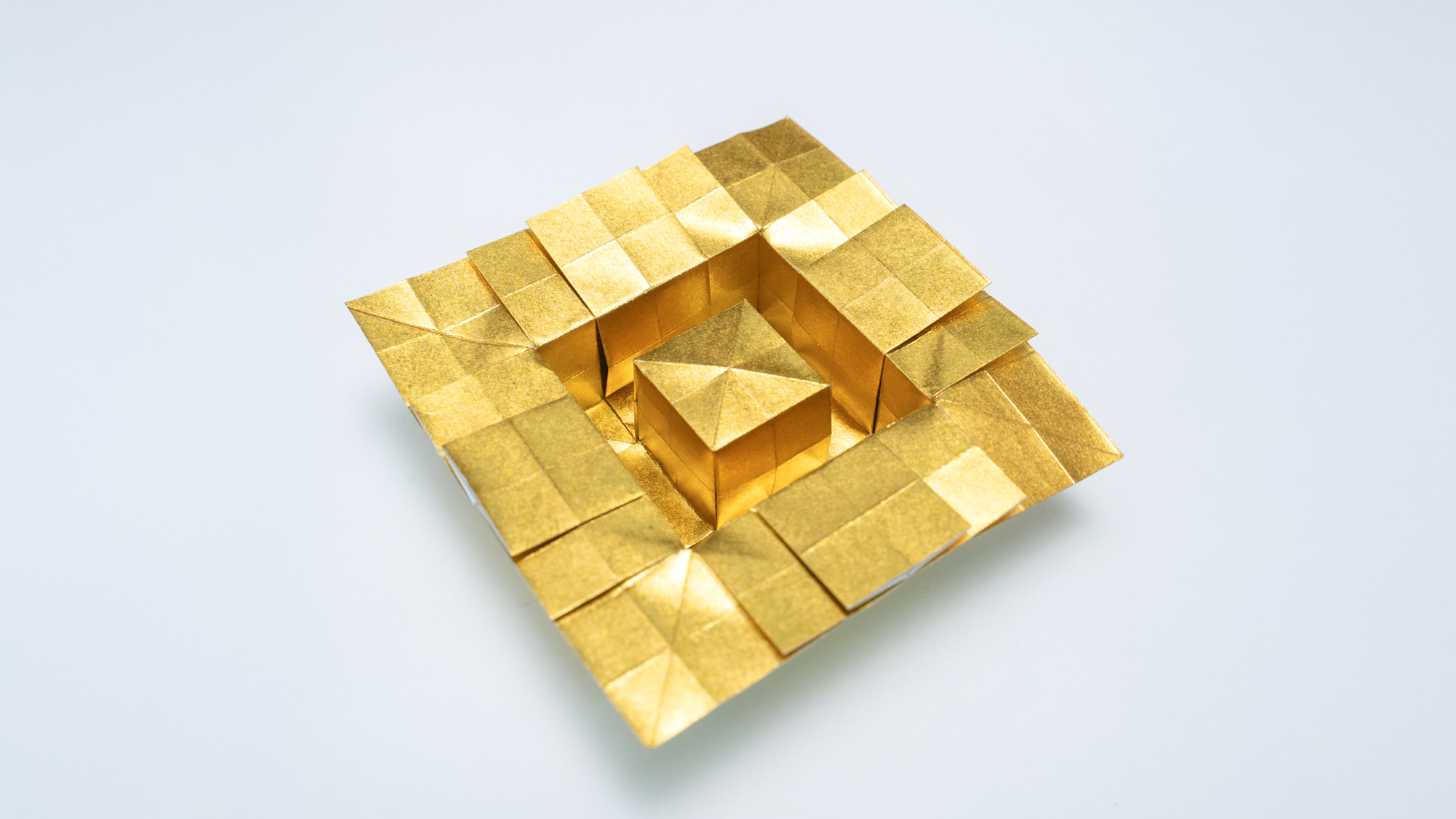
A structure in which a cube is placed at the center of a recessed rectangular prism.
A composite component created by combining a banded cube with a basic cube.
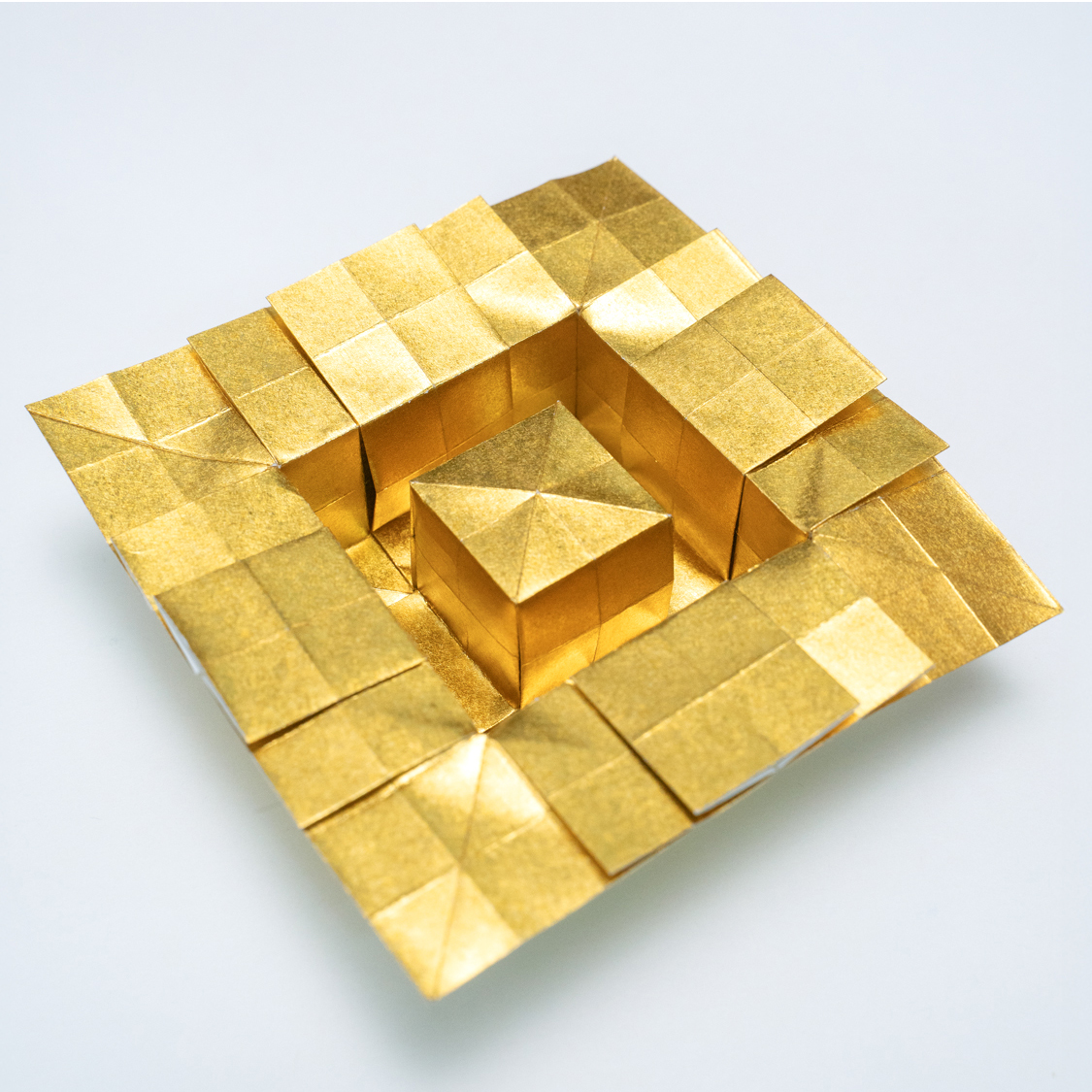
Nested Cube
A structure in which a cube is placed at the center of a recessed rectangular prism. A composite component created by combining a banded cube with a basic cube.
Understanding These Structures as Components
These polygon components share the following characteristics:
- They can function as complete forms on their own
- They can connect with other components
- They can serve as frameworks, surfaces, or decorative elements
The key is to understand that each can be treated not only as a single “shape,” but also as a structural unit within a larger construction.
By understanding each component and applying combination, transformation, and repetition, it becomes possible to design more complex and convincing three-dimensional origami structures.
Polygon Components as a Design Philosophy
By consciously working with polygon components, it becomes possible to systematically design three-dimensional forms that are structurally self-supporting.
This is because some polygon components possess strong inherent structural properties. By using these as the framework of a work, stable three-dimensional forms can be folded without the aid of wire, adhesives, or other reinforcements.
This design philosophy also allows for the combination of conventional flat molecules with polygon components. Since each face of a polygon component is planar, it can support forms created using flat molecules.
By layering a structural layer (polygon components) with an expressive layer (flat molecules applied to faces), it becomes possible to create more sculptural expressions.
This approach expands origami from a folding technique into a design practice for constructing three-dimensional structures, and is a design philosophy that can be applied to a wide range of expressions.
Expanding the Origami Design Space Through Non-Flat Molecules
Polygon components are a type of origami molecule characterized by their non-flat nature, serving as design units that construct volume through faces and corners.
By adopting design approaches that do not assume flat-foldability, origami opens up into a sculptural expressive domain.
Using polygon components, Kamiori-Studio pursues origami expressions in which metaphorical representation and sculptural mass overlap, allowing realism and abstraction to be perceived simultaneously.
On this site, we introduce a wide variety of polygon components along with their folding methods and structural principles. We encourage you to try folding each one and experience the moment when volume rises from the paper. If you find the appeal of three-dimensional expression there, we hope you will also explore designing your own works centered on polygon components.